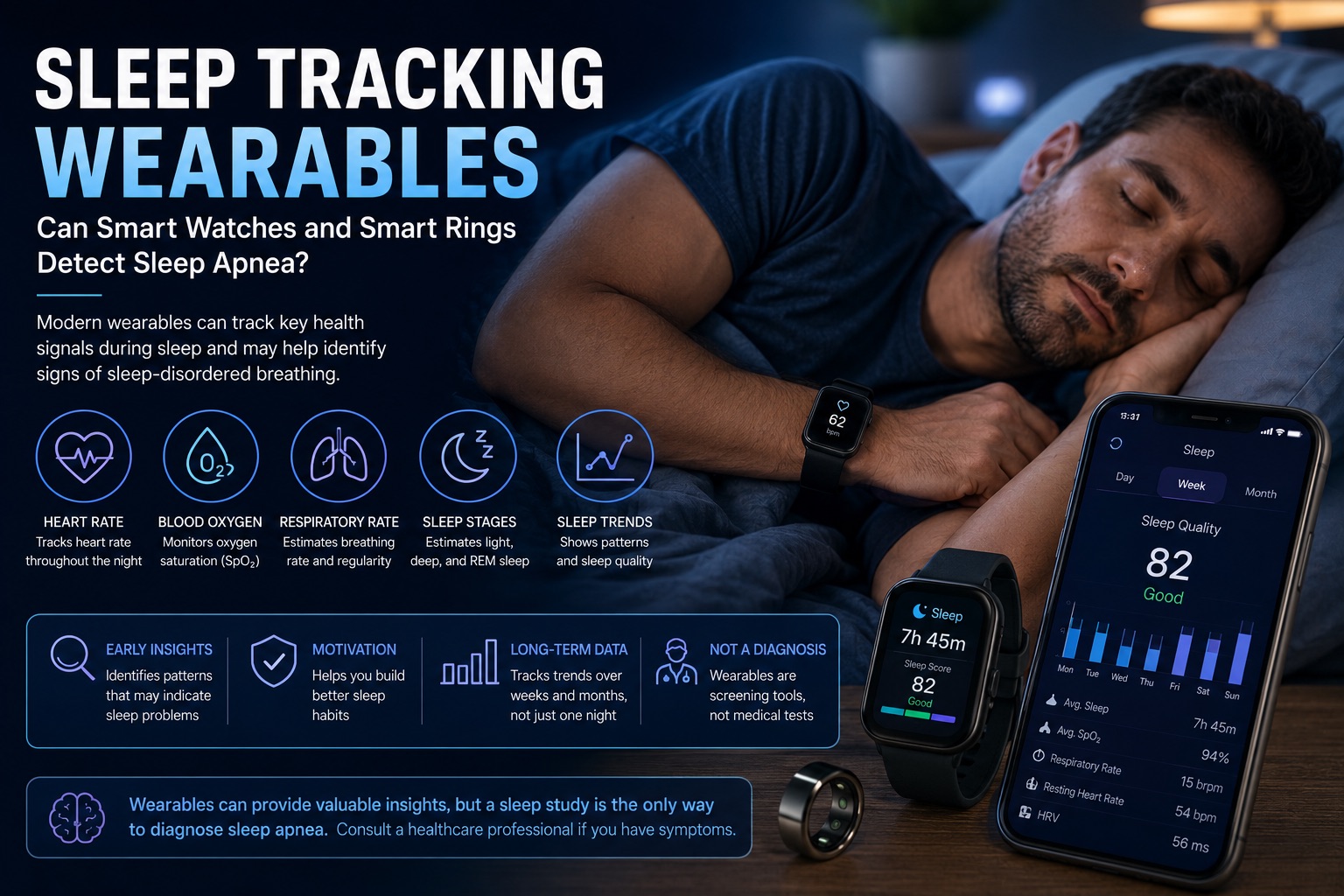
Sleep tracking wearables: can smart watches and smart rings detect sleep apnea?
Wearable technology has transformed the way people monitor their health. What began as simple step counters has evolved into sophisticated devices capable of tracking heart rate, blood oxygen levels, temperature changes, movement patterns, and even estimated sleep stages.
Today, millions of people use smart watches, smart rings, fitness bands, and other wearable devices to better understand their sleep. Many users discover unusual nighttime patterns through these devices and begin to wonder whether they might have sleep apnea or another sleep disorder.
But how accurate are sleep tracking wearables, and can they actually diagnose sleep apnea?
What are sleep tracking wearables?
Sleep tracking wearables are devices worn on the body that collect physiological data during sleep.
Common examples include:
- Smart watches
- Smart rings
- Fitness trackers
- Sleep-monitoring wristbands
- Specialized medical wearables
Using combinations of sensors and algorithms, these devices estimate various aspects of sleep and recovery.
What do wearables measure?
Modern sleep trackers may monitor:
Heart rate
Continuous heart rate monitoring helps identify changes that occur throughout different sleep stages.
Heart Rate Variability (HRV)
HRV measures variations between heartbeats and is commonly used as an indicator of recovery, stress, and autonomic nervous system activity.
Blood oxygen saturation (SpO₂)
Some devices include optical sensors capable of estimating oxygen levels throughout the night.
Movement
Accelerometers detect body movement and help estimate periods of sleep and wakefulness.
Skin temperature
Temperature trends may provide insights into sleep quality, recovery, and overall health.
Breathing patterns
Advanced devices can estimate respiratory rate and identify irregular breathing trends.
How do wearables estimate sleep stages?
Unlike laboratory polysomnography, wearables do not directly measure brain activity.
Instead, they use algorithms that combine:
- Movement data
- Heart rate patterns
- Heart rate variability
- Respiratory signals
- Temperature measurements
Based on these inputs, the device estimates:
- Awake periods
- Light sleep
- Deep sleep
- REM sleep
Although accuracy continues to improve, these estimates should not be considered equivalent to medical-grade sleep studies.
Can wearables detect sleep apnea?
The answer is both yes and no.
What wearables can do
Many modern devices can identify patterns associated with sleep apnea, including:
- Oxygen desaturation events
- Irregular breathing
- Elevated overnight heart rate
- Sleep fragmentation
- Repeated awakenings
Some devices can even notify users that breathing disturbances may warrant medical evaluation.
What wearables cannot do
Most wearables cannot definitively determine:
- Whether a breathing event was obstructive or central
- Actual airflow restriction
- Respiratory effort
- Precise apnea duration
- Accurate apnea-hypopnea index (AHI)
As a result, wearable devices should be viewed as screening tools rather than diagnostic tools.
Consumer wearables versus medical devices
One of the biggest misconceptions is that all sleep tracking devices provide medical-grade information.
In reality, there are major differences.
Consumer devices
Designed primarily for:
- Wellness monitoring
- Fitness tracking
- Sleep habit awareness
- Recovery insights
Examples include smart watches and smart rings marketed directly to consumers.
Medical-grade wearables
Designed for:
- Clinical monitoring
- Diagnostic support
- Professional interpretation
- Regulatory compliance
These systems undergo significantly more validation and testing than typical consumer products.
Advantages of sleep tracking wearables
Long-term monitoring
Unlike a single-night sleep study, wearables can collect data every night.
Convenience
Most devices are comfortable enough for daily use.
Increased awareness
Users often discover sleep problems they were previously unaware of.
Motivation
Tracking data may encourage healthier sleep habits and better treatment adherence.
Trend analysis
Months of data can reveal meaningful patterns that would be impossible to observe during a single sleep study.
Limitations of wearables
Despite their popularity, wearables have important limitations.
Limited accuracy
Performance varies significantly between manufacturers and models.
Algorithm differences
Different devices may report very different sleep results from the same night.
No direct brain monitoring
Without EEG measurements, sleep stage estimates remain approximations.
False reassurance
Normal wearable data does not necessarily mean a sleep disorder is absent.
False alarms
Some devices may incorrectly flag normal variations as potential health concerns.
Popular wearable technologies
Several categories dominate the sleep monitoring market.
Smart watches
Common features include:
- Heart rate monitoring
- Oxygen monitoring
- Sleep stage estimation
- Activity tracking
Smart rings
Ring-based devices often focus on:
- Sleep quality
- Recovery
- Heart rate variability
- Temperature trends
Fitness bands
These devices provide affordable sleep monitoring and wellness tracking.
Medical wearables
Specialized systems may be prescribed or recommended by healthcare providers for more detailed monitoring.
When should wearable data be taken seriously?
Users should consider professional evaluation if wearable devices repeatedly indicate:
- Frequent oxygen drops
- Irregular breathing
- Severe sleep fragmentation
- Persistent poor sleep quality
- Elevated resting heart rate during sleep
These findings do not confirm a sleep disorder but may justify further investigation.
Should wearables replace sleep studies?
No.
Although wearable technology has improved dramatically, it cannot replace Home Sleep Tests or Polysomnography when an accurate diagnosis is needed.
Sleep specialists continue to rely on clinical testing because it provides detailed physiological information that wearables cannot currently capture.
However, wearables can serve as valuable screening tools and help individuals recognize when professional evaluation may be appropriate.
The future of wearable sleep technology
Artificial intelligence, improved sensor technology, and advanced data analysis continue to enhance the capabilities of wearable devices.
Future generations may offer:
- Better breathing analysis
- Improved oxygen monitoring
- More accurate sleep staging
- Earlier detection of sleep disorders
- Enhanced integration with healthcare providers
As technology advances, the gap between consumer monitoring and clinical assessment will likely continue to narrow.
Sleep tracking wearables have become powerful tools for understanding sleep habits, recovery, and overall wellness. While they cannot currently diagnose sleep apnea or replace professional sleep studies, they can identify patterns that may indicate a problem and encourage users to seek medical evaluation. Used appropriately, wearable technology can provide valuable insights, increase awareness of sleep health, and complement—not replace—evidence-based sleep medicine.