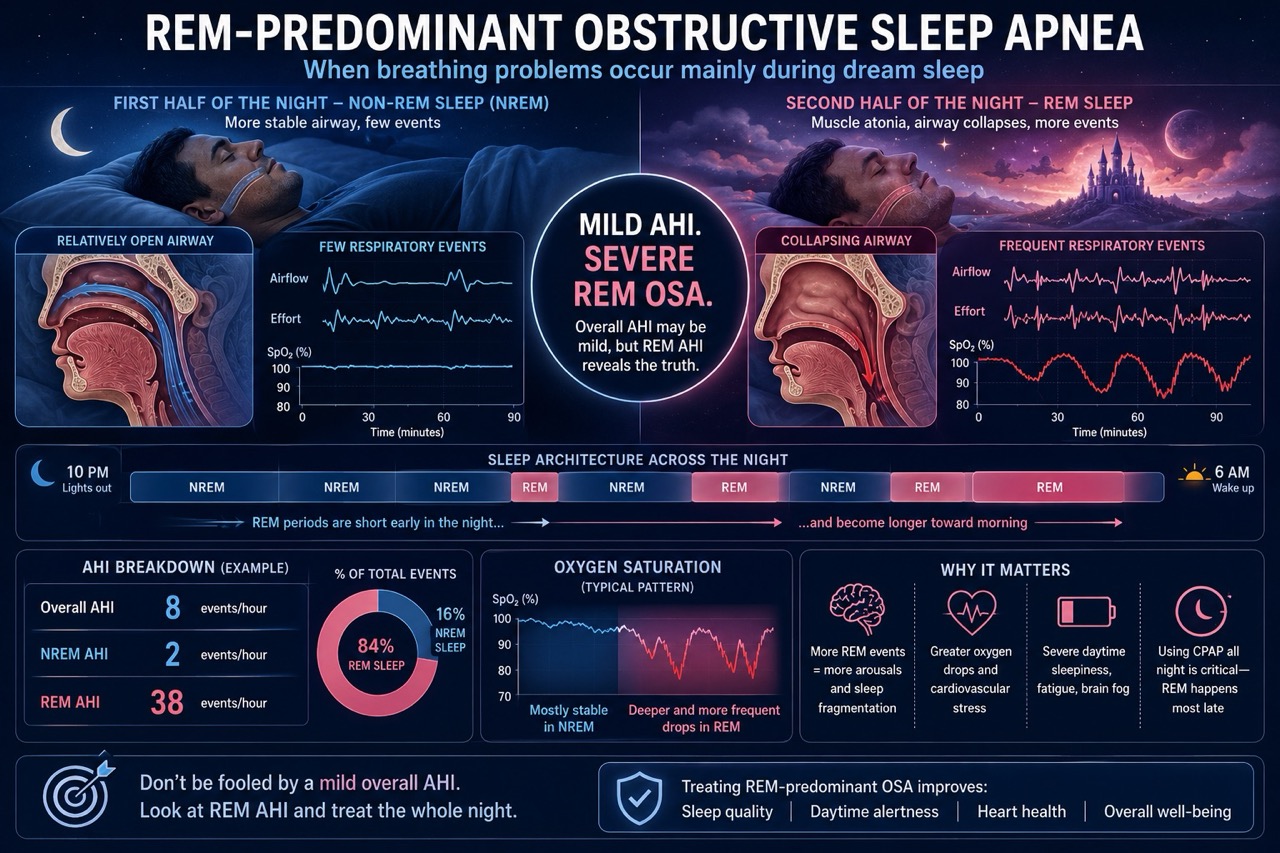
REM-predominant obstructive sleep apnea: when breathing problems occur mainly during dream sleep
Not all sleep apnea occurs evenly throughout the night.
Many patients experience most of their respiratory events during rapid eye movement (REM) sleep, a stage commonly associated with vivid dreaming, emotional processing, and memory consolidation.
In some individuals, breathing may be relatively stable during non-REM sleep yet deteriorate dramatically during REM sleep.
This pattern is known as REM-predominant obstructive sleep apnea (REM-OSA).
Because traditional severity classifications rely heavily on overall AHI, REM-related disease may be underestimated despite producing significant symptoms and physiological stress.
Understanding REM-predominant sleep apnea helps explain why some patients experience severe fatigue, profound oxygen desaturation, or persistent symptoms despite apparently mild overall disease.
What is REM sleep?
Sleep is divided into two broad categories:
Non-REM sleep
Includes:
- N1
- N2
- N3 (deep sleep)
These stages comprise approximately 75–80% of total sleep.
REM sleep
Rapid Eye Movement sleep typically accounts for:
- 20–25% of total sleep time
Characteristics include:
- Dreaming
- Memory consolidation
- Emotional processing
- Muscle paralysis (atonia)
The final feature is particularly important in sleep apnea.
Why breathing worsens during REM sleep
During REM sleep, most skeletal muscles become temporarily paralyzed.
This includes many muscles responsible for maintaining upper airway stability.
As muscle tone decreases:
- The tongue falls backward more easily
- The soft palate becomes more collapsible
- Airway resistance increases
- Obstruction becomes more likely
Even patients with relatively stable breathing during non-REM sleep may develop substantial airway collapse during REM sleep.
What is REM-predominant OSA?
Although definitions vary among studies, REM-predominant OSA generally refers to:
- Respiratory events occurring primarily during REM sleep
- REM AHI substantially higher than non-REM AHI
A common example:
- Overall AHI = 10
- Non-REM AHI = 3
- REM AHI = 42
Traditional classification labels the patient as having mild OSA.
However, REM sleep contains periods of severe airway obstruction.
Why overall AHI can be misleading
AHI averages respiratory events across the entire night.
This averaging process may conceal significant REM-related disease.
Consider two patients.
Patient A
- AHI = 12
- Events distributed evenly
Patient B
- AHI = 12
- Nearly all events occur during REM sleep
The physiological consequences may differ substantially.
Patient B experiences repeated airway collapse during a sleep stage that is already associated with heightened cardiovascular activity and autonomic instability.
Oxygen desaturation tends to be worse during REM sleep
Respiratory events occurring during REM sleep are often:
- Longer
- More complete
- Associated with deeper oxygen desaturation
Several physiological factors contribute:
- Reduced airway muscle tone
- Altered ventilatory responses
- Greater airway collapsibility
As a result, REM-related events frequently generate higher hypoxic burden than similar events occurring during non-REM sleep.
Cardiovascular implications
REM sleep is characterized by:
- Variable heart rate
- Blood pressure fluctuations
- Increased sympathetic activity
Adding recurrent airway obstruction to this environment may amplify cardiovascular stress.
Research suggests REM-related OSA may contribute to:
- Hypertension
- Metabolic dysfunction
- Cardiovascular disease
- Increased sympathetic activation
even when overall AHI appears relatively modest.
Why women are more commonly affected
Several studies suggest REM-predominant OSA occurs more frequently in women.
Possible reasons include:
- Differences in airway anatomy
- Hormonal influences
- Distinct patterns of airway collapse
Because women often present with lower overall AHIs, REM-related disease may contribute to underdiagnosis or delayed treatment.
Symptoms of REM-predominant OSA
Patients commonly report:
- Excessive daytime sleepiness
- Morning fatigue
- Brain fog
- Difficulty concentrating
- Memory complaints
- Non-restorative sleep
Many are surprised when symptoms appear disproportionately severe relative to their overall AHI score.
REM-related disease may explain this discrepancy.
Why CPAP usage duration matters
Many patients remove CPAP during the second half of the night.
This can be problematic.
REM sleep becomes progressively more abundant toward morning.
As a result:
- Early-night CPAP use may cover relatively little REM sleep
- Late-night CPAP removal may leave the most vulnerable period untreated
A patient using CPAP for only four hours may miss a significant portion of REM-related events.
This is one reason clinicians emphasize all-night adherence.
How REM-predominant OSA is diagnosed
Diagnosis requires polysomnography or a sleep study capable of identifying sleep stages.
Clinicians evaluate:
- Total AHI
- REM AHI
- Non-REM AHI
- Oxygen desaturation patterns
- Sleep architecture
Reviewing only the overall AHI may miss important REM-specific findings.
Clinical implications
REM-predominant OSA highlights one of the major limitations of relying exclusively on overall AHI.
Patients with modest overall event counts may still experience:
- Severe REM-related obstruction
- Significant hypoxia
- Pronounced symptoms
- Increased cardiovascular stress
Recognition of REM-specific disease allows more accurate risk assessment and treatment planning.
The future of sleep apnea classification
Modern sleep medicine increasingly recognizes that OSA is not a single uniform disorder.
Patients differ in:
- Airway anatomy
- Collapse patterns
- Oxygen response
- Sleep-stage vulnerability
REM-predominant OSA represents one of several clinically meaningful phenotypes that help explain why patients with similar AHIs often experience very different outcomes.
Key takeaways
- REM sleep produces greater upper airway collapsibility.
- Respiratory events during REM sleep are often longer and associated with deeper oxygen desaturation.
- Patients may have severe REM-related disease despite mild overall AHI.
- REM-predominant OSA is particularly common in women.
- CPAP adherence throughout the entire night is important because REM sleep becomes more frequent toward morning.
- Evaluating REM AHI provides important information that may not be apparent from overall AHI alone.
References
- American Academy of Sleep Medicine (AASM) Manual for the Scoring of Sleep and Associated Events.
- Mokhlesi B, Punjabi NM. REM-Related Obstructive Sleep Apnea.
- Malhotra A, Ayappa I, Ayas N, et al. Metrics of Sleep Apnea Severity Beyond the Apnea-Hypopnea Index.
- Eckert DJ. Phenotypic Approaches to Obstructive Sleep Apnea.
x
Introduction
Not all sleep apnea occurs evenly throughout the night.
Many patients experience most of their respiratory events during rapid eye movement (REM) sleep, a stage commonly associated with vivid dreaming, emotional processing, and memory consolidation.
In some individuals, breathing may be relatively stable during non-REM sleep yet deteriorate dramatically during REM sleep.
This pattern is known as REM-predominant obstructive sleep apnea (REM-OSA).
Because traditional severity classifications rely heavily on overall AHI, REM-related disease may be underestimated despite producing significant symptoms and physiological stress.
Understanding REM-predominant sleep apnea helps explain why some patients experience severe fatigue, profound oxygen desaturation, or persistent symptoms despite apparently mild overall disease.
What is REM sleep?
Sleep is divided into two broad categories:
Non-REM sleep
Includes:
- N1
- N2
- N3 (deep sleep)
These stages comprise approximately 75–80% of total sleep.
REM sleep
Rapid Eye Movement sleep typically accounts for:
- 20–25% of total sleep time
Characteristics include:
- Dreaming
- Memory consolidation
- Emotional processing
- Muscle paralysis (atonia)
The final feature is particularly important in sleep apnea.
Why breathing worsens during REM sleep
During REM sleep, most skeletal muscles become temporarily paralyzed.
This includes many muscles responsible for maintaining upper airway stability.
As muscle tone decreases:
- The tongue falls backward more easily
- The soft palate becomes more collapsible
- Airway resistance increases
- Obstruction becomes more likely
Even patients with relatively stable breathing during non-REM sleep may develop substantial airway collapse during REM sleep.
What is REM-predominant OSA?
Although definitions vary among studies, REM-predominant OSA generally refers to:
- Respiratory events occurring primarily during REM sleep
- REM AHI substantially higher than non-REM AHI
A common example:
- Overall AHI = 10
- Non-REM AHI = 3
- REM AHI = 42
Traditional classification labels the patient as having mild OSA.
However, REM sleep contains periods of severe airway obstruction.
Why overall AHI can be misleading
AHI averages respiratory events across the entire night.
This averaging process may conceal significant REM-related disease.
Consider two patients.
Patient A
- AHI = 12
- Events distributed evenly
Patient B
- AHI = 12
- Nearly all events occur during REM sleep
The physiological consequences may differ substantially.
Patient B experiences repeated airway collapse during a sleep stage that is already associated with heightened cardiovascular activity and autonomic instability.
Oxygen desaturation tends to be worse during REM sleep
Respiratory events occurring during REM sleep are often:
- Longer
- More complete
- Associated with deeper oxygen desaturation
Several physiological factors contribute:
- Reduced airway muscle tone
- Altered ventilatory responses
- Greater airway collapsibility
As a result, REM-related events frequently generate higher hypoxic burden than similar events occurring during non-REM sleep.
Cardiovascular implications
REM sleep is characterized by:
- Variable heart rate
- Blood pressure fluctuations
- Increased sympathetic activity
Adding recurrent airway obstruction to this environment may amplify cardiovascular stress.
Research suggests REM-related OSA may contribute to:
- Hypertension
- Metabolic dysfunction
- Cardiovascular disease
- Increased sympathetic activation
even when overall AHI appears relatively modest.
Why women are more commonly affected
Several studies suggest REM-predominant OSA occurs more frequently in women.
Possible reasons include:
- Differences in airway anatomy
- Hormonal influences
- Distinct patterns of airway collapse
Because women often present with lower overall AHIs, REM-related disease may contribute to underdiagnosis or delayed treatment.
Symptoms of REM-predominant OSA
Patients commonly report:
- Excessive daytime sleepiness
- Morning fatigue
- Brain fog
- Difficulty concentrating
- Memory complaints
- Non-restorative sleep
Many are surprised when symptoms appear disproportionately severe relative to their overall AHI score.
REM-related disease may explain this discrepancy.
Why CPAP usage duration matters
Many patients remove CPAP during the second half of the night.
This can be problematic.
REM sleep becomes progressively more abundant toward morning.
As a result:
- Early-night CPAP use may cover relatively little REM sleep
- Late-night CPAP removal may leave the most vulnerable period untreated
A patient using CPAP for only four hours may miss a significant portion of REM-related events.
This is one reason clinicians emphasize all-night adherence.
How REM-predominant OSA is diagnosed
Diagnosis requires polysomnography or a sleep study capable of identifying sleep stages.
Clinicians evaluate:
- Total AHI
- REM AHI
- Non-REM AHI
- Oxygen desaturation patterns
- Sleep architecture
Reviewing only the overall AHI may miss important REM-specific findings.
Clinical implications
REM-predominant OSA highlights one of the major limitations of relying exclusively on overall AHI.
Patients with modest overall event counts may still experience:
- Severe REM-related obstruction
- Significant hypoxia
- Pronounced symptoms
- Increased cardiovascular stress
Recognition of REM-specific disease allows more accurate risk assessment and treatment planning.
The future of sleep apnea classification
Modern sleep medicine increasingly recognizes that OSA is not a single uniform disorder.
Patients differ in:
- Airway anatomy
- Collapse patterns
- Oxygen response
- Sleep-stage vulnerability
REM-predominant OSA represents one of several clinically meaningful phenotypes that help explain why patients with similar AHIs often experience very different outcomes.
Key takeaways
- REM sleep produces greater upper airway collapsibility.
- Respiratory events during REM sleep are often longer and associated with deeper oxygen desaturation.
- Patients may have severe REM-related disease despite mild overall AHI.
- REM-predominant OSA is particularly common in women.
- CPAP adherence throughout the entire night is important because REM sleep becomes more frequent toward morning.
- Evaluating REM AHI provides important information that may not be apparent from overall AHI alone.
References
- American Academy of Sleep Medicine (AASM) Manual for the Scoring of Sleep and Associated Events.
- Mokhlesi B, Punjabi NM. REM-Related Obstructive Sleep Apnea.
- Malhotra A, Ayappa I, Ayas N, et al. Metrics of Sleep Apnea Severity Beyond the Apnea-Hypopnea Index.
- Eckert DJ. Phenotypic Approaches to Obstructive Sleep Apnea.