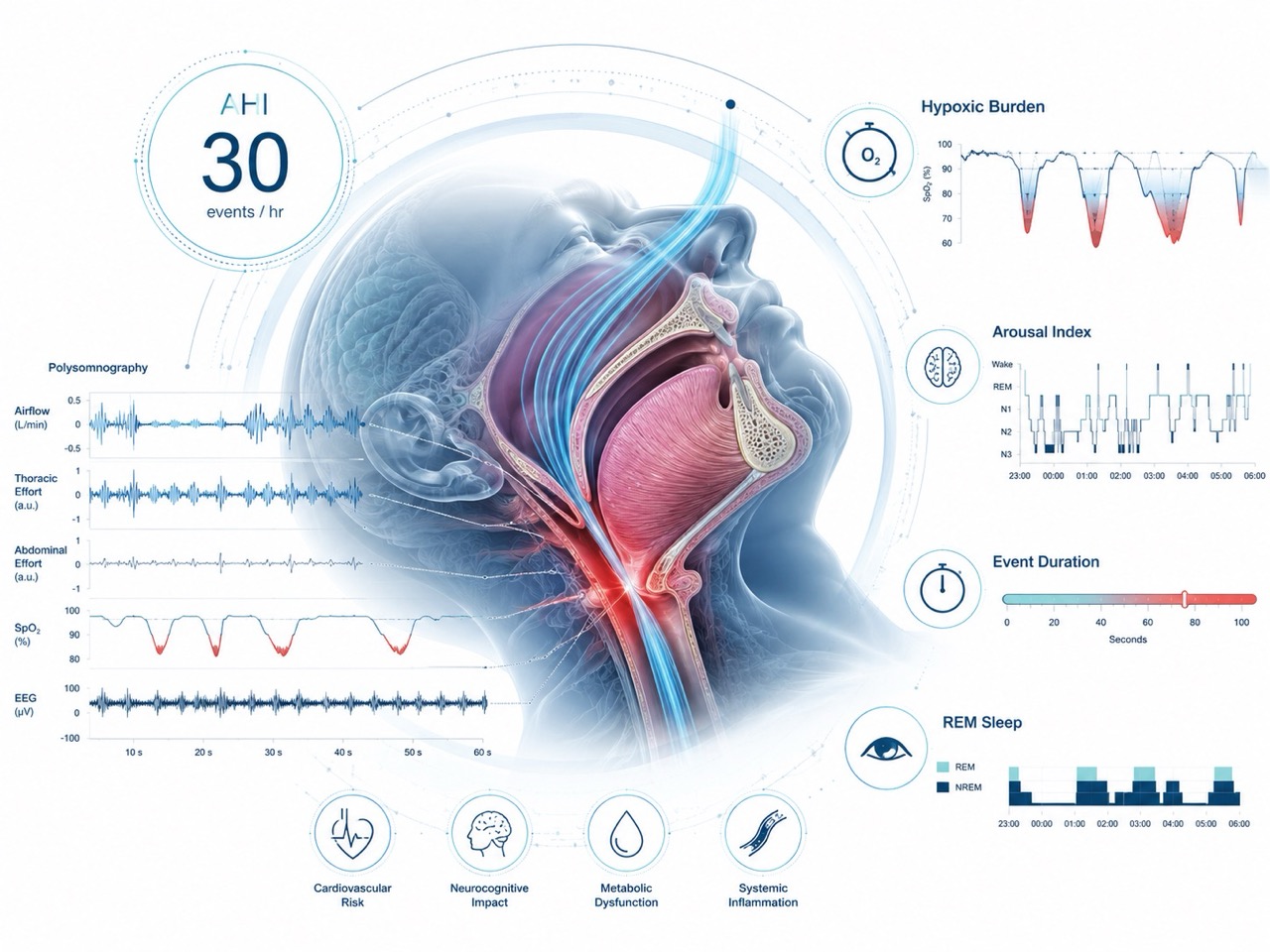
AHI is not enough: understanding the limitations of the apnea-hypopnea index
For decades, the Apnea-Hypopnea Index (AHI) has served as the primary metric for diagnosing and classifying obstructive sleep apnea (OSA). Patients are commonly categorized as having mild, moderate, or severe disease based almost entirely on the number of respiratory events recorded per hour of sleep.
While AHI remains a valuable diagnostic tool, growing evidence suggests that it provides only a partial picture of disease severity. Two patients with identical AHIs may experience dramatically different physiological consequences, symptom burdens, and long-term health outcomes.
As sleep medicine evolves toward precision-based approaches, clinicians and researchers are increasingly recognizing that respiratory event frequency alone cannot fully characterize the complexity of sleep-disordered breathing.
This article explores the strengths and limitations of AHI, emerging alternative metrics, and the implications for clinical practice.
What is AHI?
The Apnea-Hypopnea Index represents the average number of apneas and hypopneas occurring per hour of sleep.
The calculation is straightforward:
AHI = (Number of Apneas + Number of Hypopneas) ÷ Total Sleep Hours
Current classification thresholds are:
| Severity | AHI |
|---|---|
| Normal | < 5 |
| Mild OSA | 5–14.9 |
| Moderate OSA | 15–29.9 |
| Severe OSA | ≥ 30 |
Because of its simplicity and reproducibility, AHI became the cornerstone of OSA diagnosis and remains central to most treatment guidelines.
However, simplicity comes with important limitations.
The problem: not all respiratory events are equal
AHI treats every qualifying respiratory event equally.
A 10-second hypopnea associated with a 3% oxygen desaturation receives the same weight as a 90-second obstructive apnea causing profound oxygen deprivation.
Clinically, these events are not equivalent.
Consider two patients:
Patient A
- AHI: 30 events/hour
- Most events last 10–12 seconds
- Minimal oxygen desaturation
- Lowest SpO₂: 89%
Patient B
- AHI: 30 events/hour
- Frequent events lasting 40–60 seconds
- Significant oxygen desaturation
- Lowest SpO₂: 72%
Despite having identical AHIs, Patient B experiences substantially greater physiological stress.
Yet traditional classification places both patients in the same severity category.
Duration matters
AHI counts events but ignores their duration.
A patient with fewer but prolonged apneas may experience greater oxygen deprivation than another patient with numerous brief events.
Several studies have demonstrated that apnea duration influences:
- Sympathetic nervous system activation
- Oxidative stress
- Blood pressure fluctuations
- Cardiac workload
- End-organ damage
Unfortunately, event duration contributes little to standard severity classifications.
Oxygen desaturation burden matters
The primary biological consequence of obstructive sleep apnea is intermittent hypoxia.
Repeated cycles of oxygen deprivation and reoxygenation trigger:
- Oxidative stress
- Inflammation
- Endothelial dysfunction
- Metabolic dysregulation
- Cardiovascular remodeling
AHI measures event frequency but not the magnitude of oxygen disruption.
A patient may experience:
- Frequent mild events with little desaturation
- Fewer events causing profound hypoxemia
These scenarios produce different biological effects despite similar AHI values.
Arousal burden matters
Many respiratory events terminate with cortical arousals.
Although these arousals are often too brief to be remembered by the patient, they fragment sleep architecture and reduce restorative sleep quality.
Repeated arousals contribute to:
- Excessive daytime sleepiness
- Cognitive dysfunction
- Mood disturbances
- Impaired memory consolidation
- Reduced quality of life
AHI does not account for the frequency or severity of sleep fragmentation.
Consequently, some patients with relatively modest AHI values may report severe symptoms, while others with higher AHI values remain relatively asymptomatic.
Why symptoms often do not match AHI
One of the most common frustrations in sleep medicine is the apparent disconnect between AHI and symptom severity.
Clinicians frequently encounter patients who:
- Have mild OSA but severe daytime sleepiness
- Have severe OSA but minimal subjective symptoms
This discrepancy occurs because sleep apnea affects multiple physiological systems beyond event frequency.
Factors influencing symptom burden include:
- Sleep fragmentation
- REM sleep involvement
- Oxygen desaturation severity
- Individual susceptibility
- Age
- Comorbid conditions
- Genetic factors
AHI captures only one component of this complex picture.
The rise of hypoxic burden
One of the most promising alternative metrics is hypoxic burden.
Unlike AHI, hypoxic burden quantifies the cumulative impact of oxygen desaturation associated with respiratory events.
Rather than simply counting events, hypoxic burden measures:
- Depth of desaturation
- Duration of desaturation
- Total physiological oxygen stress
Recent studies suggest that hypoxic burden may correlate more strongly with:
- Cardiovascular disease
- Heart failure
- Stroke risk
- All-cause mortality
than traditional AHI measurements.
This has led many researchers to view hypoxic burden as a potentially superior marker of disease severity.
REM-related sleep apnea: another limitation of AHI
Some patients experience respiratory events predominantly during rapid eye movement (REM) sleep.
Because REM typically occupies only 20–25% of total sleep time, these patients may have relatively modest overall AHI values.
However, REM sleep is associated with:
- Greater upper airway collapsibility
- Longer respiratory events
- More severe oxygen desaturation
- Increased sympathetic activation
As a result, REM-predominant OSA may carry risks that are not adequately reflected by overall AHI.
Positional sleep apnea
Body position significantly influences airway collapse.
Some patients experience severe respiratory disturbance while sleeping supine but minimal abnormalities when sleeping laterally.
A single nightly AHI may fail to communicate these positional differences.
Recognizing positional dependence can have major treatment implications, including positional therapy as an alternative or adjunct to positive airway pressure.
Toward a multidimensional assessment of OSA
Many experts now advocate for a multidimensional approach to sleep apnea severity assessment.
Potential components include:
Respiratory event frequency
Traditional AHI.
Hypoxic burden
Total oxygen desaturation impact.
Sleep fragmentation
Arousal index and sleep continuity measures.
Event duration
Average and maximum apnea length.
REM involvement
REM-specific respiratory indices.
Positional dependence
Supine versus non-supine severity.
Symptom burden
Sleepiness, fatigue, and quality-of-life measures.
Together, these metrics provide a more complete representation of disease severity than AHI alone.
Clinical implications
AHI remains an essential diagnostic tool and will likely continue to play a central role in sleep medicine.
However, clinicians should avoid relying exclusively on AHI when evaluating patients.
Two individuals with identical AHIs may have vastly different risks, symptoms, and treatment needs.
Comprehensive assessment should incorporate:
- Oxygen desaturation metrics
- Sleep fragmentation measures
- Clinical symptoms
- Comorbid conditions
- Event characteristics
- Patient-centered outcomes
As research advances, the future of sleep apnea assessment is likely to move beyond simple event counting toward a more personalized and physiologically meaningful understanding of disease severity.
Key takeaways
- AHI measures event frequency but not physiological impact.
- Event duration and oxygen desaturation are not adequately reflected in AHI.
- Sleep fragmentation contributes significantly to symptoms and quality of life.
- Patients with identical AHIs may have markedly different cardiovascular and neurocognitive risks.
- Emerging metrics such as hypoxic burden may better predict long-term outcomes.
- Modern sleep medicine increasingly favors multidimensional assessment over reliance on a single index.
References
- American Academy of Sleep Medicine (AASM). The AASM Manual for the Scoring of Sleep and Associated Events.
- Azarbarzin A, Sands SA, Taranto-Montemurro L, et al. The Sleep Apnea-Specific Hypoxic Burden Predicts Incident Heart Failure.
- Malhotra A, Ayappa I, Ayas N, et al. Metrics of Sleep Apnea Severity Beyond the Apnea-Hypopnea Index.
- Punjabi NM. The Epidemiology of Adult Obstructive Sleep Apnea.
- Eckert DJ. Phenotypic Approaches to Obstructive Sleep Apnea.