Positional obstructive sleep apnea: why sleeping on your back can dramatically worsen breathing
Not all obstructive sleep apnea behaves the same way throughout the night.
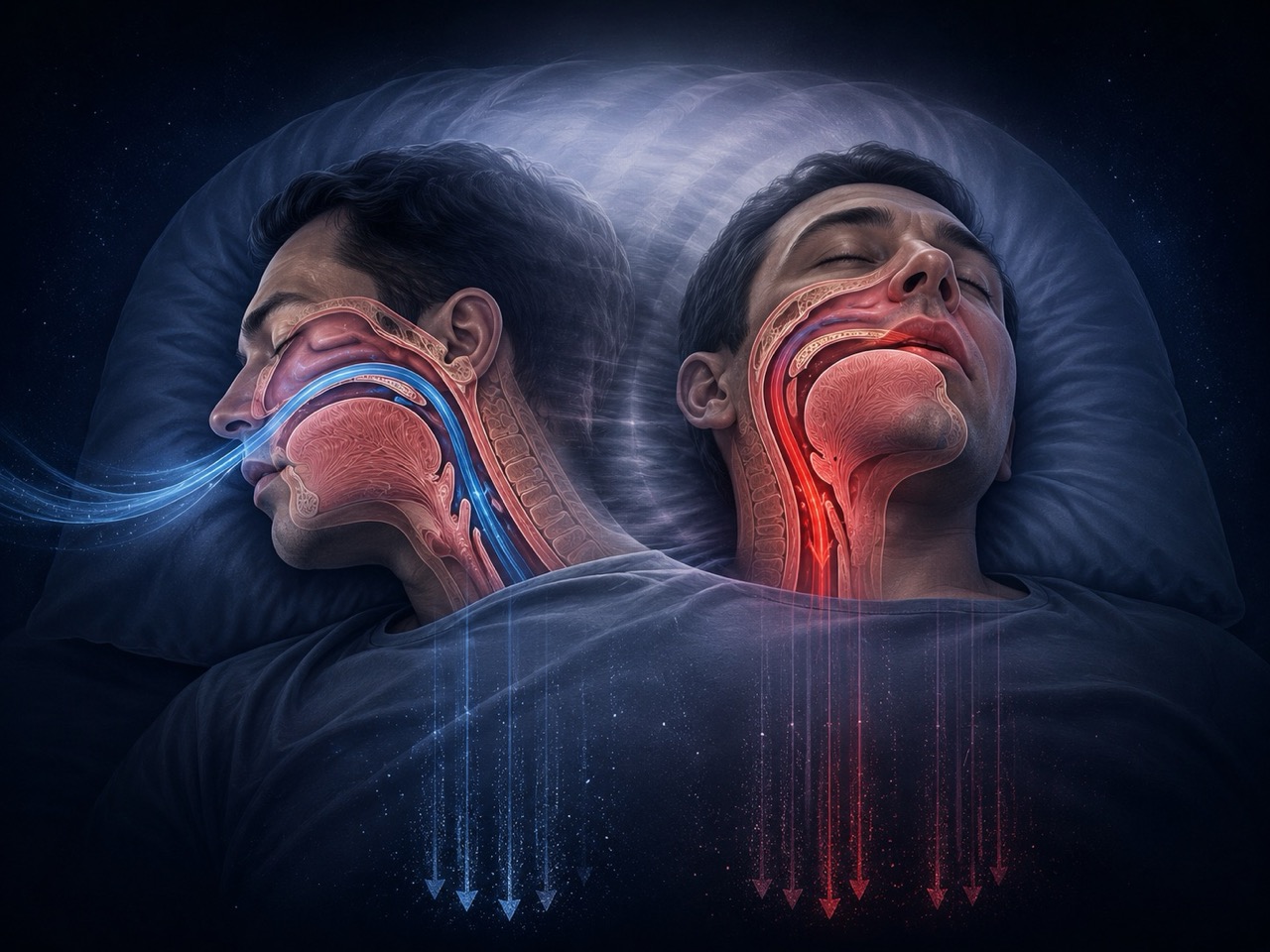
While some patients experience breathing disturbances regardless of sleeping position, others demonstrate a striking pattern: respiratory events occur predominantly when sleeping on their back.
This condition is known as positional obstructive sleep apnea (POSA).
In some cases, changing sleep position can reduce the number of respiratory events by more than 50%, dramatically altering disease severity.
Understanding positional sleep apnea helps explain why some patients experience highly variable sleep study results, inconsistent symptoms, or substantial improvement with positional therapy.
What is positional obstructive sleep apnea?
Positional OSA occurs when respiratory events are significantly more common in the supine position (lying on the back) than in other sleeping positions.
Although definitions vary, positional OSA is commonly identified when:
- Supine AHI is at least twice the non-supine AHI
Example:
- Supine AHI = 40
- Side-sleeping AHI = 10
This patient would generally be considered to have positional sleep apnea.
Why does sleeping position matter?
Gravity plays a major role in upper airway stability.
When lying on the back:
- The tongue tends to fall posteriorly
- The soft palate moves toward the airway
- The pharyngeal walls become more collapsible
- Airway resistance increases
These effects narrow the airway and increase the likelihood of obstruction.
When sleeping on the side, gravity shifts these structures away from the airway, often improving airflow.
What happens inside the airway?
Imagine the airway as a flexible tube.
In an upright position, surrounding muscles help maintain its shape.
During sleep:
- Muscle tone decreases
- Airway support weakens
In the supine position, gravity adds further pressure on already vulnerable structures.
The result is:
- Increased airway narrowing
- More flow limitation
- More hypopneas
- More apneas
- Greater oxygen desaturation
How common is positional OSA?
Positional OSA is surprisingly common.
Studies suggest that:
- Approximately 50–60% of patients with obstructive sleep apnea demonstrate some degree of positional dependence.
The condition appears particularly common among:
- Mild OSA
- Moderate OSA
- Younger patients
- Lower BMI individuals
As disease severity increases, positional dependence often becomes less pronounced because airway collapse occurs in all positions.
Positional OSA versus non-positional OSA
Positional OSA
- Events occur mainly when supine
- Side sleeping significantly improves breathing
- Positional therapy may be effective
Non-positional OSA
- Events occur in all positions
- Side sleeping provides limited improvement
- More comprehensive treatment is often required
Recognizing this distinction is important when selecting treatment strategies.
How sleep studies identify positional OSA
Modern sleep studies record body position throughout the night.
The final report often includes:
- Overall AHI
- Supine AHI
- Non-supine AHI
- Percentage of sleep spent supine
Patients are often surprised to discover that most severe events occurred during a relatively small portion of the night spent on their back.
Why overall AHI may be misleading
Consider two patients.
Patient A
- Overall AHI = 20
- Similar event frequency in all positions
Patient B
- Overall AHI = 20
- Supine AHI = 50
- Side-sleeping AHI = 4
Despite identical overall AHIs, the treatment implications may differ significantly.
Patient B may benefit substantially from positional therapy.
Positional therapy
Positional therapy aims to reduce time spent sleeping on the back.
Historically, patients used:
- Tennis balls sewn into shirts
- Backpacks
- Foam devices
Modern approaches include:
- Vibrating positional trainers
- Smart wearable devices
- Specialized sleep positioning systems
These devices gently encourage side sleeping without fully awakening the patient.
Can positional therapy replace CPAP?
Sometimes.
Positional therapy may be appropriate for selected patients with:
- Mild positional OSA
- Moderate positional OSA
- Strong positional dependence
However, it is generally less effective when:
- OSA remains severe in lateral positions
- Significant oxygen desaturation occurs
- Multiple collapse sites are present
Many patients still require PAP therapy.
Position and CPAP therapy
Even among CPAP users, sleeping position remains important.
Supine sleep often requires:
- Higher therapeutic pressures
- Greater airway support
- More aggressive treatment settings
Some patients experience lower residual AHI and improved comfort simply by reducing supine sleep.
The relationship with REM sleep
Positional OSA and REM-predominant OSA frequently overlap.
REM sleep increases airway collapsibility.
Supine sleep further narrows the airway.
When both occur simultaneously, respiratory events may become particularly severe.
This combination often produces:
- Longer events
- Deeper oxygen desaturation
- Greater hypoxic burden
than either factor alone.
The future of personalized treatment
Sleep medicine increasingly recognizes that not all obstructive sleep apnea is the same.
Important disease characteristics include:
- Position dependence
- REM dependence
- Hypoxic burden
- Flow limitation
- Airway collapse patterns
Understanding these individual traits allows treatment to be tailored to the patient rather than relying solely on overall AHI.
Key takeaways
- Positional OSA occurs when breathing disturbances are significantly worse during back sleeping.
- Gravity increases upper airway collapse in the supine position.
- Many patients experience dramatic reductions in AHI when sleeping on their side.
- Sleep studies routinely measure body position and position-specific AHI.
- Positional therapy may benefit carefully selected patients.
- Position dependence represents an important OSA phenotype beyond traditional AHI classification.
References
- American Academy of Sleep Medicine (AASM) Clinical Guidelines.
- Cartwright RD. Effect of Sleep Position on Sleep Apnea Severity.
- Joosten SA et al. Positional Therapy in Obstructive Sleep Apnea.
- Eckert DJ. Phenotypic Approaches to Obstructive Sleep Apnea.