Flow limitation: the respiratory signal most patients never hear about
Most patients diagnosed with sleep apnea eventually learn about terms such as AHI, oxygen saturation, and CPAP pressure settings.
Yet one of the most important respiratory signals in modern sleep medicine often goes completely unmentioned: flow limitation.
Flow limitation can occur long before a complete apnea develops. In many patients, it contributes significantly to sleep fragmentation, daytime fatigue, and reduced sleep quality even when oxygen levels remain relatively normal.
Because it often does not qualify as an apnea or hypopnea, flow limitation may be overlooked by patients reviewing their sleep reports. However, sleep physicians, technologists, and advanced PAP devices increasingly recognize it as a critical marker of upper airway dysfunction.
Understanding flow limitation helps explain why some individuals remain symptomatic despite apparently mild sleep apnea or normal oxygen saturation levels.
What is flow limitation?
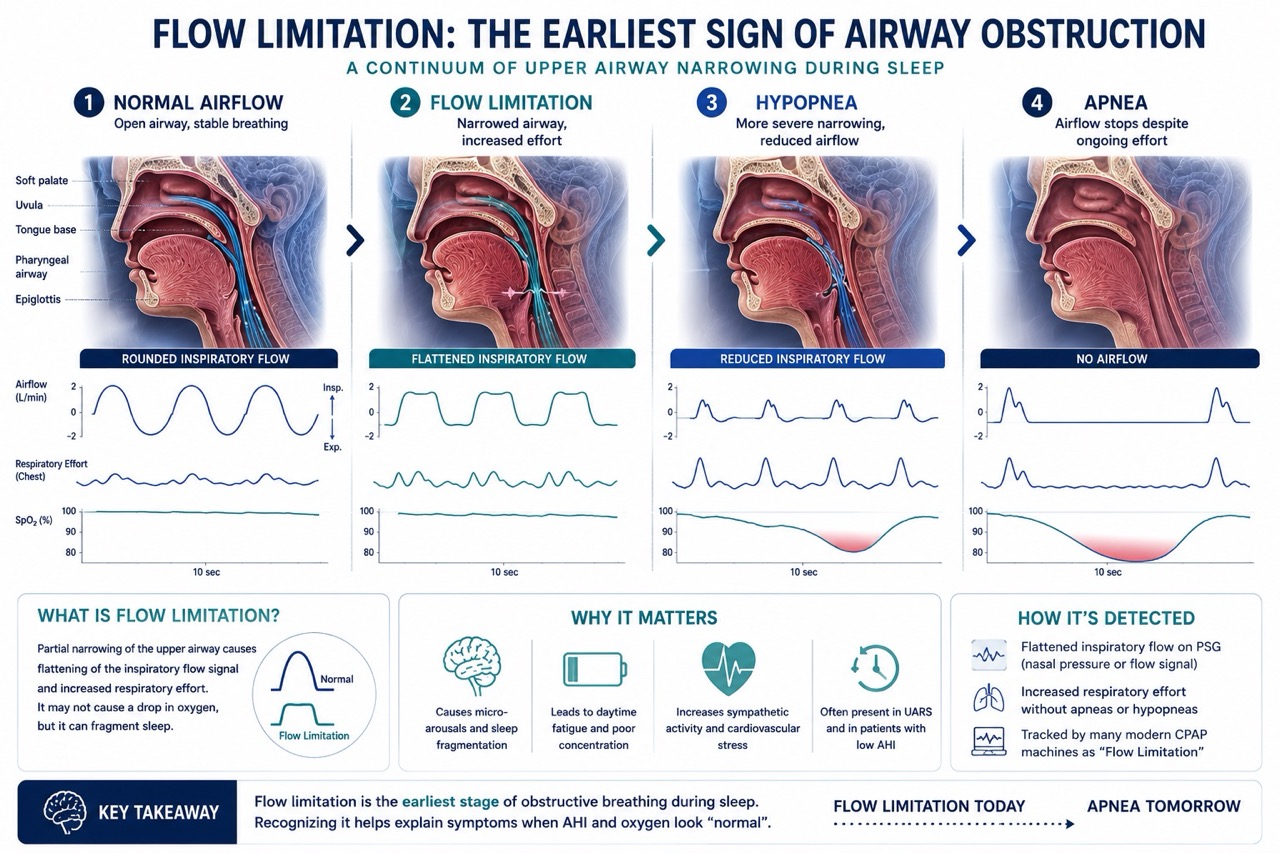
Flow limitation occurs when airflow becomes partially restricted despite continued respiratory effort.
The airway remains open enough to allow breathing, but not open enough to allow normal airflow.
As a result:
- Breathing becomes less efficient
- Respiratory effort increases
- Sleep stability decreases
- Arousals become more likely
Unlike an apnea, airflow does not stop completely.
Unlike many hypopneas, oxygen saturation may remain relatively unchanged.
Yet the physiological impact can still be significant.
What happens inside the airway?
During sleep, muscles supporting the upper airway relax.
In susceptible individuals, structures such as:
- Soft palate
- Lateral pharyngeal walls
- Tongue base
- Epiglottis
begin to narrow the airway.
This narrowing creates resistance to airflow.
The lungs continue attempting to draw air inward, but the partially collapsed airway limits flow.
The result is a characteristic flattening of the inspiratory airflow signal.
This flattened pattern is the hallmark of flow limitation.
Why flow limitation matters
Many people assume sleep-disordered breathing becomes important only when oxygen levels fall.
This is not always true.
Flow limitation can trigger:
- Increased respiratory effort
- Micro-arousals
- Sleep fragmentation
- Sympathetic activation
- Reduced sleep efficiency
without producing significant oxygen desaturation.
Consequently, patients may experience:
- Chronic fatigue
- Non-restorative sleep
- Morning headaches
- Brain fog
- Daytime sleepiness
despite apparently normal oxygen levels.
How flow limitation appears on a sleep study
Normal inspiratory airflow typically has a smooth, rounded appearance.
When flow limitation develops, the inspiratory portion becomes flattened.
Sleep technologists often describe this as:
- Flattened inspiratory contour
- Plateaued airflow
- Inspiratory truncation
The pattern reflects increasing upper airway resistance.
As resistance worsens, respiratory effort increases until an arousal or respiratory event occurs.
Flow limitation and RERAs
Flow limitation is closely linked to respiratory effort-related arousals (RERAs).
The typical sequence is:
- Airway narrows.
- Flow limitation develops.
- Respiratory effort increases.
- Brain briefly arouses.
- Airway reopens.
The patient often has no memory of awakening.
However, repeated cycles may occur hundreds of times per night.
This is one reason patients can experience severe symptoms despite relatively low AHI values.
Flow limitation and upper airway resistance syndrome (UARS)
Upper Airway Resistance Syndrome is perhaps the condition most strongly associated with flow limitation.
Patients with UARS frequently demonstrate:
- Normal or near-normal AHI
- Minimal oxygen desaturation
- Elevated RDI
- Frequent flow limitation
- Significant daytime impairment
Without evaluation of flow limitation, these patients may be incorrectly reassured that their sleep study is normal.
Can CPAP machines detect flow limitation?
Many modern PAP devices continuously monitor airflow patterns.
Manufacturers use proprietary algorithms to identify:
- Inspiratory flattening
- Flow restriction
- Increased upper airway resistance
Some machines display a dedicated Flow Limitation graph.
Persistent flow limitation despite low AHI may indicate:
- Insufficient pressure
- Positional airway collapse
- Residual upper airway resistance
- Incomplete treatment optimization
This is one reason low AHI does not always mean optimal therapy.
Flow limitation versus apnea
| Feature | Flow Limitation | Apnea |
|---|---|---|
| Airflow present | Yes | Minimal or absent |
| Oxygen desaturation | Often minimal | Common |
| Respiratory effort | Increased | Increased |
| Sleep fragmentation | Common | Common |
| Included in AHI | Usually no | Yes |
| Included in RDI indirectly | Often yes | Yes |
Flow limitation often represents an earlier stage of airway dysfunction.
Apneas and hypopneas may be viewed as more severe manifestations of the same underlying process.
Why patients with low AHI may still feel unwell
One of the most common clinical puzzles occurs when a patient reports:
“I still feel exhausted, but my AHI is only 1.”
Flow limitation may provide the answer.
Even when apnea events are effectively controlled, residual airway resistance can continue to disrupt sleep architecture.
In these situations, attention to:
- Flow limitation
- Leak management
- Sleep fragmentation
- Pressure optimization
may improve outcomes more than focusing solely on AHI.
The future of sleep medicine
Historically, sleep medicine focused on counting respiratory events.
Today, the field increasingly recognizes that sleep-disordered breathing exists along a continuum.
Flow limitation represents one of the earliest measurable manifestations of upper airway dysfunction.
As precision sleep medicine evolves, metrics such as:
- Flow limitation
- RDI
- Hypoxic burden
- Arousal burden
may become as important as traditional AHI measurements.
Understanding these subtler abnormalities allows clinicians to better explain symptoms and individualize treatment strategies.
Key takeaways
- Flow limitation occurs when airflow becomes restricted without complete airway collapse.
- It often causes sleep fragmentation despite normal oxygen levels.
- Flow limitation is closely linked to RERAs and elevated RDI.
- Many patients with UARS exhibit significant flow limitation despite low AHI.
- Modern CPAP devices can often detect and track flow limitation.
- Persistent flow limitation may explain ongoing symptoms even when AHI appears well controlled.
References
- American Academy of Sleep Medicine (AASM) Scoring Manual.
- Guilleminault C. Upper Airway Resistance Syndrome.
- Malhotra A, Ayappa I, Ayas N, et al. Metrics of Sleep Apnea Severity Beyond the Apnea-Hypopnea Index.
- Eckert DJ. Pathophysiology and Phenotypes of Obstructive Sleep Apnea.