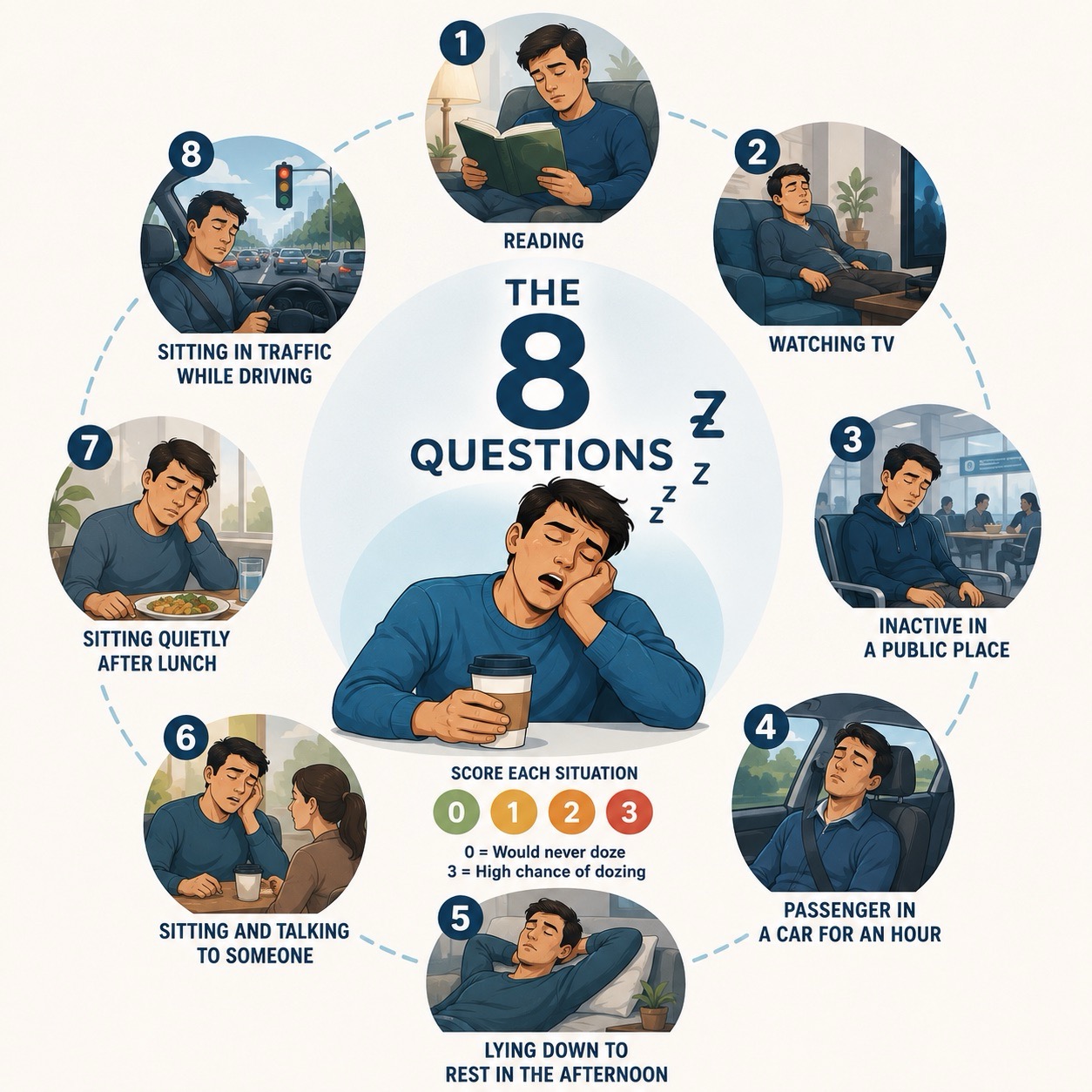
The 8 Questions of the Epworth Sleepiness Scale Explained
Why these eight situations reveal more about your sleep than you might think.
The Epworth Sleepiness Scale (ESS) is one of the most widely used questionnaires in sleep medicine. At first glance, the questions seem surprisingly simple.
Could you fall asleep while reading?
What about watching television?
Or sitting quietly after lunch?
These situations were not chosen randomly. Each one was carefully selected to measure a person’s natural tendency to fall asleep during everyday life.
Let’s look at what each question is really asking.
How the ESS Works
For each situation, you rate your likelihood of dozing off:
- 0 = Would never doze
- 1 = Slight chance
- 2 = Moderate chance
- 3 = High chance
The final score ranges from 0 to 24.
The higher the score, the greater your level of daytime sleepiness.
Question 1: Sitting and Reading
Imagine reading a book, magazine, newspaper, or article.
Reading is a quiet, passive activity that provides little physical stimulation.
Most well-rested people remain fully awake.
If you frequently drift off while reading, it may suggest excessive sleepiness.
Why This Question Matters
Reading often reveals subtle sleepiness before people notice it elsewhere.
Question 2: Watching Television
Television is one of the most common situations where sleepiness appears.
The room is usually comfortable.
Movement is limited.
Mental engagement varies.
Many people with untreated sleep disorders report falling asleep during television programs they genuinely wanted to watch.
Why This Question Matters
TV watching removes many external demands that normally help keep us awake.
Question 3: Sitting Inactive in a Public Place
Examples include:
- Waiting rooms
- Theaters
- Conferences
- Church services
- Lectures
In these environments, you’re expected to sit quietly for an extended period.
Why This Question Matters
It measures your ability to remain alert even when stimulation is low.
Question 4: Riding as a Passenger in a Car for an Hour
This question does not refer to driving.
It refers to sitting as a passenger.
The gentle motion of a vehicle can reveal sleepiness surprisingly quickly.
Why This Question Matters
Many people with excessive daytime sleepiness fall asleep during long journeys even when they did not intend to.
Question 5: Lying Down to Rest in the Afternoon
This is one of the easiest situations for almost anyone to fall asleep.
That is why some degree of sleepiness is expected.
The question is not whether you could sleep.
The question is how likely you are to doze off.
Why This Question Matters
It helps establish a baseline for your natural sleep tendency.
Question 6: Sitting and Talking to Someone
This is often the most surprising question.
Conversation usually keeps people alert.
Falling asleep during an active social interaction is unusual.
Why This Question Matters
A high score here often indicates significant daytime sleepiness.
Question 7: Sitting Quietly After Lunch
This question assumes no alcohol consumption.
Many people experience a natural dip in alertness after eating.
The ESS measures whether that dip becomes actual sleepiness.
Why This Question Matters
Sleep disorders often become most noticeable during this period.
Question 8: Sitting in a Car While Stopped in Traffic
This situation was added because it has important safety implications.
The question does not ask whether you have fallen asleep.
It asks whether you might.
Why This Question Matters
Excessive sleepiness behind the wheel can be dangerous, even during short stops.
Which Questions Matter Most?
There is no single “most important” question.
The ESS works because all eight situations together provide a picture of your daytime sleepiness.
However, high scores on questions involving:
- Conversations
- Public places
- Traffic situations
often attract particular attention because these activities normally keep people awake.
What Is a Normal Score?
0–10
Generally considered normal.
11–14
Mild excessive daytime sleepiness.
15–17
Moderate excessive daytime sleepiness.
18–24
Severe excessive daytime sleepiness.
What a High Score Does Not Mean
A high ESS score does not automatically mean you have sleep apnea.
It can also be associated with:
- Narcolepsy
- Chronic sleep deprivation
- Insomnia
- Shift work
- Certain medications
- Other sleep disorders
The ESS measures symptoms, not causes.
The eight questions of the Epworth Sleepiness Scale may seem simple, but together they provide a remarkably effective snapshot of how sleepiness affects everyday life.
By focusing on common situations rather than asking whether you “feel tired,” the ESS helps identify people whose daytime alertness may be impaired. While it cannot diagnose sleep apnea or other sleep disorders, it remains one of the most useful screening tools in sleep medicine.