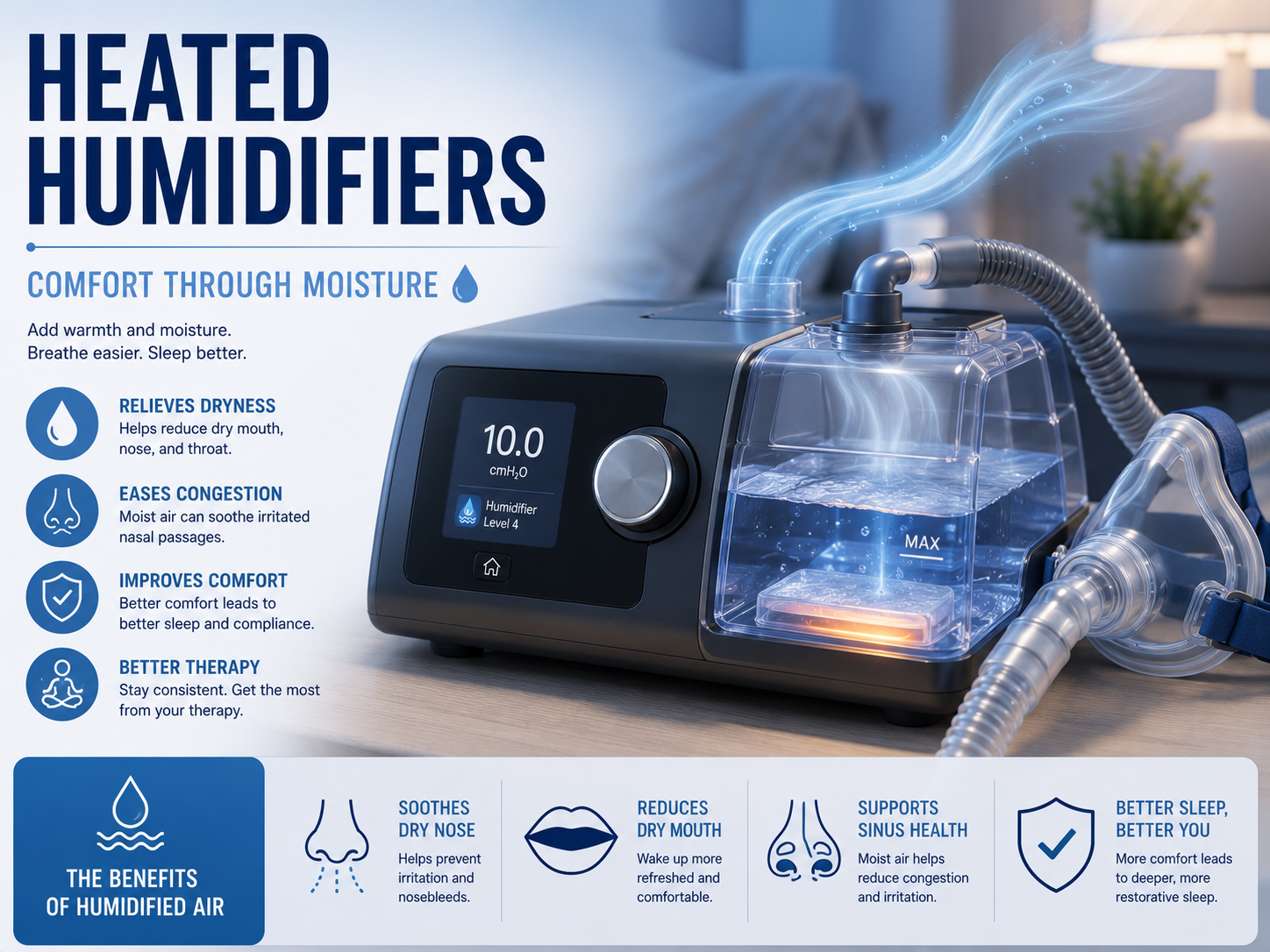
Heated humidifiers: improving comfort during CPAP therapy
For many people, the biggest challenge of PAP therapy is not the machine itself—it’s the side effects of breathing pressurized air throughout the night. Dry mouth, nasal irritation, congestion, sore throat, and discomfort are among the most common complaints reported by CPAP users.
Fortunately, modern PAP systems often include a solution: heated humidification.
A heated humidifier adds warm moisture to the airflow delivered by a CPAP, APAP, BiPAP, or ASV machine. By preventing excessive drying of the airways, humidification can dramatically improve comfort and help users adapt more successfully to therapy.
For some patients, adding a humidifier is the difference between struggling with treatment and using PAP therapy comfortably every night.
What is a heated humidifier?
A heated humidifier is an accessory integrated into or attached to a PAP machine.
The system contains:
- Water chamber
- Heating plate
- Humidity controls
- Airflow pathway
As air passes through the humidifier chamber, moisture is added before the air reaches the mask.
The result is warmer, more comfortable airflow throughout the night.
Why PAP therapy can cause dryness
Normal breathing naturally humidifies incoming air through the nose.
However, PAP therapy continuously delivers airflow under pressure.
This can increase evaporation and drying of:
- Nasal passages
- Mouth
- Throat
- Airways
The effect may be more noticeable in:
- Dry climates
- Winter months
- Heated indoor environments
- Mouth breathers
Humidification helps restore moisture and reduce irritation.
Benefits of heated humidification
Reduced dry mouth
One of the most common reasons patients add humidification.
Reduced nasal dryness
Moist air is generally more comfortable than dry pressurized airflow.
Less congestion
Humidification may help reduce nasal irritation and inflammation.
Improved comfort
Many users report significantly improved therapy experience.
Better therapy compliance
Comfort improvements often lead to more consistent PAP use.
Common symptoms humidification may improve
Patients often report:
- Dry mouth
- Dry throat
- Stuffy nose
- Runny nose
- Nasal burning
- Morning discomfort
- Nosebleeds
- Sinus irritation
While not every symptom is caused by dry air, humidification frequently helps.
How heated humidifiers work
The humidifier chamber is filled with distilled water.
During therapy:
- The heating plate warms the water.
- Air passes over the chamber.
- Moisture enters the airflow.
- Humidified air reaches the mask.
Most modern systems allow users to adjust humidity levels based on personal preference.
Heated humidifier versus passover humidifier
Passover humidifier
Adds moisture without heating the water.
Advantages:
- Simpler design
- Lower power consumption
Limitations:
- Less effective in very dry environments
Heated humidifier
Adds both warmth and moisture.
Advantages:
- Greater comfort
- More effective humidification
- Better cold-weather performance
Most modern PAP users prefer heated systems.
What humidity setting should you use?
There is no universal setting.
The ideal level depends on:
- Climate
- Season
- Room temperature
- Personal comfort
- Breathing habits
Most users begin with a moderate setting and adjust gradually.
Signs humidity may be too low
- Dry mouth
- Dry nose
- Nasal irritation
Signs humidity may be too high
- Condensation
- Excessive moisture
- Water accumulation in tubing
Finding the right balance may take a few nights.
What is rainout?
Rainout occurs when warm humidified air cools inside the tubing.
This can cause:
- Water droplets
- Gurgling sounds
- Water reaching the mask
Although harmless, rainout can be annoying.
Preventing rainout
Possible solutions include:
- Heated tubing
- Tube covers
- Lower humidity settings
- Warmer room temperature
Modern heated tube systems largely eliminate this issue.
Distilled water versus tap water
Most manufacturers recommend distilled water.
Benefits include:
- Reduced mineral buildup
- Easier cleaning
- Longer equipment life
Using tap water occasionally is unlikely to cause immediate damage, but long-term use may increase mineral deposits.
Always follow manufacturer recommendations.
Cleaning the humidifier chamber
Regular maintenance is important.
Recommended practices:
- Empty daily
- Rinse regularly
- Clean according to manufacturer instructions
- Inspect for discoloration or damage
Proper maintenance supports both hygiene and equipment performance.
Do all PAP users need a humidifier?
No.
Some users experience little or no dryness.
Others find humidification essential.
Factors that increase the likelihood of needing humidification include:
- Mouth breathing
- Dry environments
- Chronic nasal irritation
- High PAP pressures
Comfort preferences also play a significant role.
Humidifiers and mask types
Nasal masks
Often benefit from humidification because airflow passes directly through the nose.
Nasal pillow masks
Humidification may help reduce nostril irritation.
Full face masks
Can reduce both nasal and oral dryness.
All mask styles may benefit from properly adjusted humidity.
Travel considerations
Many travel PAP devices support:
- Integrated humidification
- Optional humidifiers
- Compact water chambers
Some travelers choose to leave humidification at home to reduce size and weight.
Others consider it essential.
Are heated humidifiers worth it?
For many PAP users, absolutely.
The benefits often include:
- Improved comfort
- Better sleep quality
- Easier therapy adaptation
- Greater treatment compliance
Humidification is one of the most effective comfort upgrades available for PAP therapy.
Heated humidifiers are among the most valuable accessories available for PAP therapy. By adding warmth and moisture to pressurized airflow, they help reduce dryness, irritation, congestion, and other common side effects that can interfere with treatment success. Whether integrated into a CPAP machine or added as an accessory, humidification often improves comfort dramatically and helps users maintain consistent, effective sleep apnea therapy over the long term.