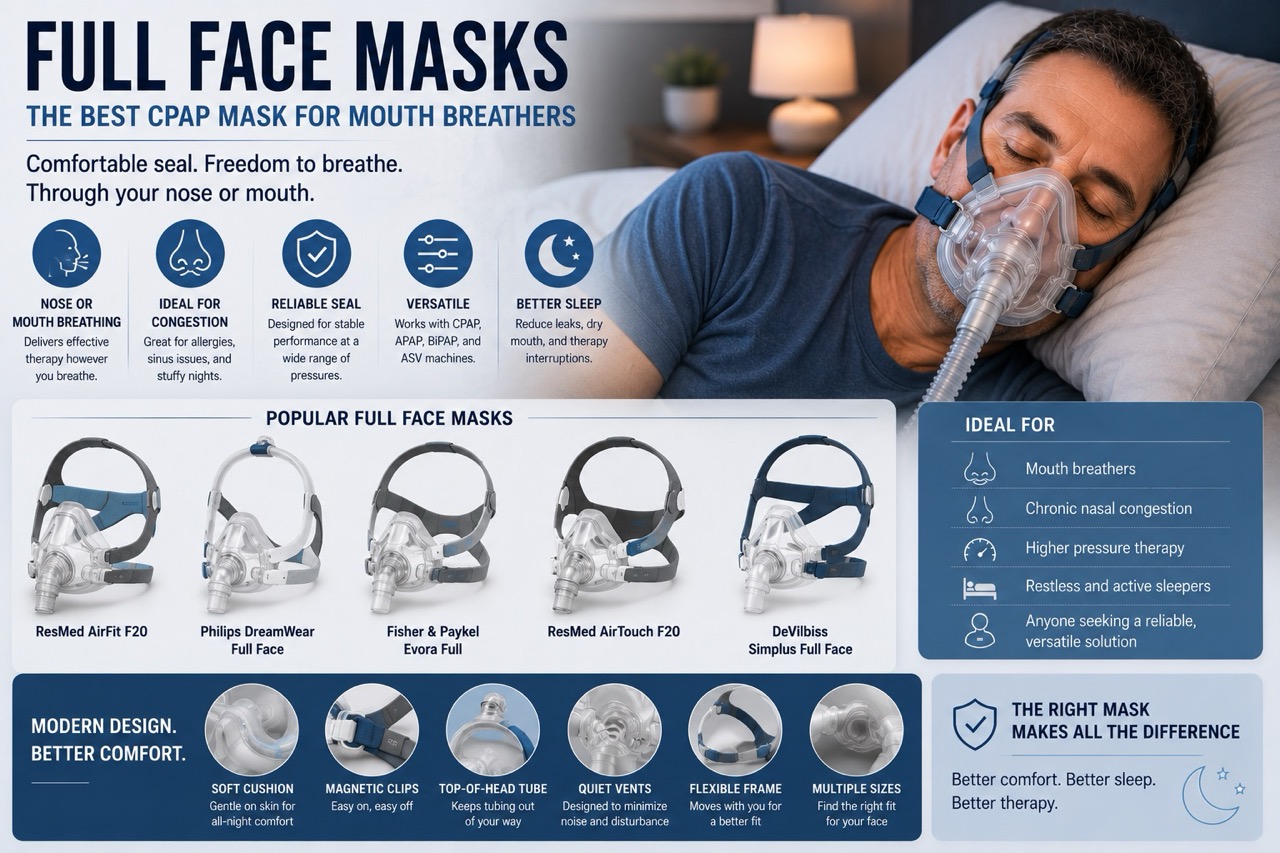
Full face masks: the best CPAP mask for mouth breathers
For many sleep apnea patients, PAP therapy becomes much easier once they find the right mask. While nasal masks and nasal pillow masks are excellent options for many users, they rely heavily on the ability to breathe comfortably through the nose.
For people who frequently breathe through their mouths during sleep, suffer from chronic nasal congestion, or require higher therapy pressures, a full face mask may be the most effective solution.
Modern full face masks have evolved significantly over the past decade. Today’s designs are lighter, quieter, more comfortable, and far less intimidating than earlier generations, making them one of the most popular mask choices in sleep medicine.
What is a full face mask?
A full face mask is a PAP therapy interface that covers both the nose and the mouth.
The mask creates a seal around the lower face and delivers pressurized airflow regardless of whether the user breathes through the nose, mouth, or both.
Full face masks can be used with:
- CPAP machines
- APAP machines
- BiPAP machines
- ASV machines
Because the mask accommodates multiple breathing pathways, it is often considered the most versatile PAP interface available.
How full face masks work
The PAP machine delivers pressurized airflow through tubing connected to the mask.
The sealed chamber allows air to enter through:
- The nose
- The mouth
This ensures continuous therapy even when nasal breathing becomes difficult during sleep.
For many patients, this flexibility significantly improves treatment effectiveness.
Why full face masks are prescribed
Sleep specialists commonly recommend full face masks for patients who:
Breathe through their mouth
One of the most common reasons for full face mask prescriptions.
Have chronic nasal congestion
Conditions such as:
- Allergies
- Sinus disease
- Deviated septum
- Chronic rhinitis
may interfere with nasal breathing.
Use higher PAP pressures
Some users find full face masks more comfortable at elevated therapy pressures.
Experience significant mouth leaks
Air escaping through the mouth can reduce therapy effectiveness when using nasal-only interfaces.
Benefits of full face masks
Works with nose or mouth breathing
The biggest advantage of full face masks is their flexibility.
Reduces therapy interruption
Nasal congestion is less likely to compromise treatment.
Effective at higher pressures
Many users tolerate higher pressures comfortably with full face designs.
Versatile therapy option
Suitable for a wide range of PAP therapies and respiratory conditions.
Helpful during illness
Temporary colds and sinus infections are often easier to manage without changing mask styles.
Who should consider a full face mask?
Full face masks may be ideal for:
- Mouth breathers
- Patients with chronic congestion
- Severe sleep apnea patients
- High-pressure PAP users
- Individuals who experience frequent mouth leaks
- Users who have struggled with nasal-only masks
Many long-term PAP users eventually try a full face mask even if they begin therapy with a nasal interface.
Full face masks versus nasal masks
Nasal Masks
Advantages:
- Smaller profile
- Less facial coverage
- Wider field of vision
Limitations:
- Depend on nasal breathing
- More vulnerable to mouth leaks
Full Face Masks
Advantages:
- Support mouth breathing
- Greater flexibility
- Better during congestion
Limitations:
- Larger size
- More facial contact
Both styles can be highly effective when matched to the right user.
Full face masks versus nasal pillow masks
Nasal Pillow Masks
- Minimal contact
- Lightweight
- Excellent visibility
Full Face Masks
- Greater breathing flexibility
- More stable airflow delivery
- Better for mouth breathers
The choice often depends on breathing habits rather than therapy effectiveness.
Common concerns about full face masks
“They look too large.”
Modern designs are significantly smaller and more streamlined than earlier models.
“They seem uncomfortable.”
Many current masks use:
- Soft silicone cushions
- Memory foam materials
- Flexible frames
to improve comfort.
“I feel claustrophobic.”
Some users do experience claustrophobia initially.
Minimal-contact full face mask designs may help reduce this sensation.
“They leak more.”
While full face masks have larger sealing surfaces, proper fitting usually minimizes leaks effectively.
Modern full face mask technology
Manufacturers have introduced numerous innovations.
Under-the-nose cushions
Reduce pressure on the nose bridge.
Top-of-head hose routing
Improves freedom of movement.
Magnetic clips
Simplify daily use.
Quiet vent technology
Reduces airflow noise.
Flexible frames
Adapt to sleeping position changes.
These improvements have made modern full face masks substantially more comfortable.
Side sleeping with a full face mask
Many users assume side sleeping is impossible with a full face mask.
In reality, many modern designs perform very well for side sleepers.
Success often depends on:
- Proper fitting
- Appropriate pillow choice
- Mask design
CPAP pillows can further improve comfort and seal stability.
Common problems and solutions
Air leaks
Possible causes:
- Incorrect size
- Overtightened straps
- Worn cushions
Dry mouth
May improve with:
- Heated humidification
- Increased humidity settings
Pressure marks
Often resolved through:
- Proper adjustment
- Alternative cushion designs
- Mask liners
Nose bridge irritation
Modern under-the-nose designs frequently reduce this issue.
Cleaning and maintenance
Routine maintenance helps ensure optimal performance.
Recommended practices include:
- Daily cushion cleaning
- Regular headgear washing
- Cushion replacement when worn
- Inspection for damage and leaks
Clean equipment improves both comfort and therapy effectiveness.
Are full face masks better than nasal masks?
Not necessarily.
For users who breathe comfortably through their nose, nasal masks and nasal pillow masks may offer greater simplicity and reduced facial contact.
For mouth breathers or individuals with chronic congestion, full face masks often provide a much better therapy experience.
The best mask is the one that supports effective treatment while remaining comfortable enough for consistent nightly use.
Full face masks remain one of the most versatile and effective PAP interfaces available. By allowing therapy through both the nose and mouth, they provide an excellent solution for mouth breathers, patients with chronic nasal congestion, and users requiring higher therapy pressures. While they involve more facial contact than other mask styles, modern full face masks offer impressive comfort, stability, and performance, making them a trusted choice for millions of sleep apnea patients worldwide.