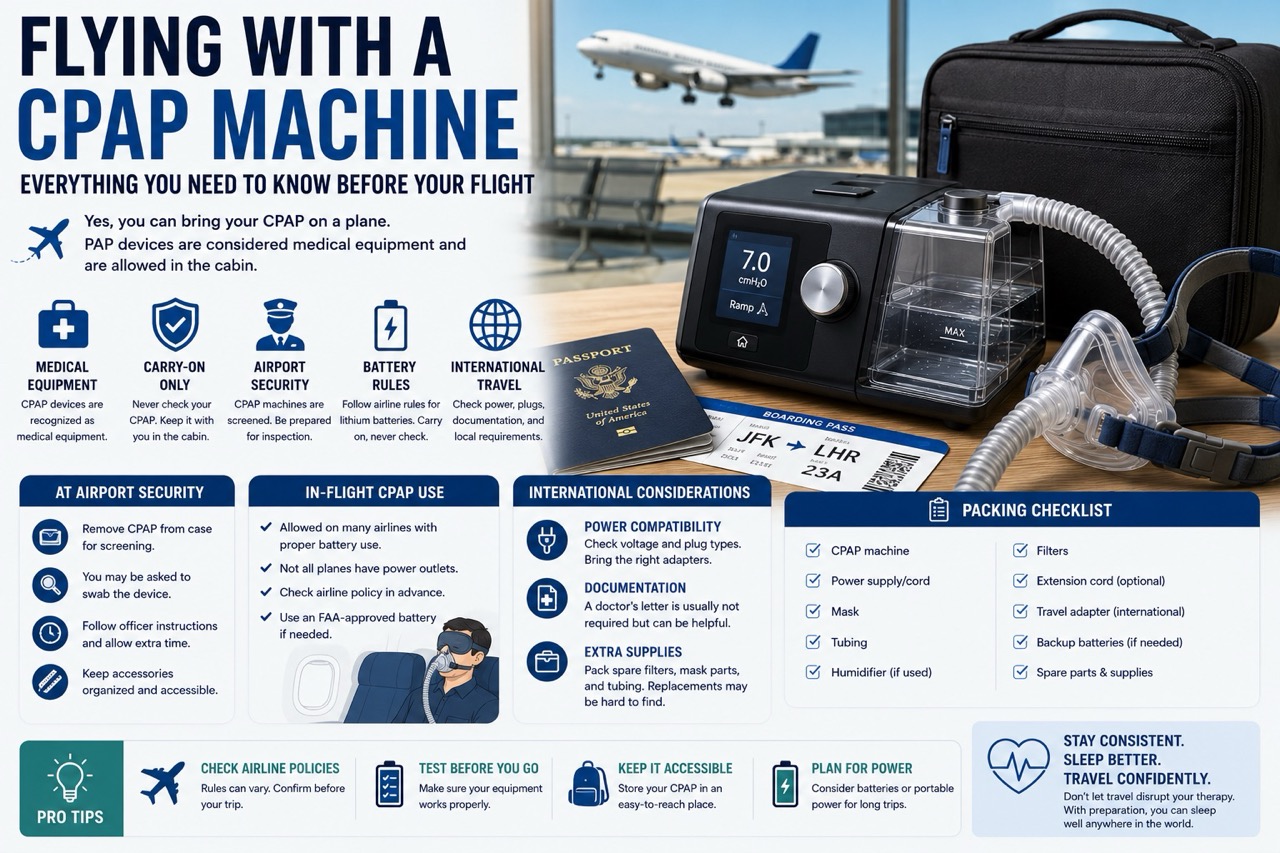
Flying with a CPAP machine: everything you need to know before your flight
For people living with sleep apnea, travel often raises an important question: can you bring a CPAP machine on an airplane?
The good news is yes.
CPAP, APAP, BiPAP, and other PAP devices are generally recognized as medical equipment and can usually be transported without difficulty. Millions of travelers fly every year with sleep apnea equipment, and airlines are accustomed to accommodating these devices.
However, proper preparation can make the experience significantly smoother. Understanding airline policies, airport security procedures, battery requirements, and travel best practices can help ensure uninterrupted therapy throughout your journey.
Can you bring a CPAP machine on a plane?
In most countries, yes.
PAP devices are generally considered medical equipment.
This means they are typically allowed in the aircraft cabin and often do not count toward standard carry-on baggage limits.
Policies vary slightly between airlines, but CPAP transportation is widely supported worldwide.
Why you should never check your CPAP
Experienced travelers almost universally recommend carrying PAP equipment into the cabin.
Reasons include:
- Risk of lost luggage
- Equipment damage
- Delayed baggage
- Exposure to extreme temperatures
Your CPAP machine is a medical device and should remain with you whenever possible.
Carry-on transportation is generally the safest option.
Going through airport security
Most PAP users experience no major difficulties during security screening.
The device may be inspected similarly to:
- Laptops
- Tablets
- Medical electronics
Depending on airport procedures, security personnel may ask you to remove the machine from its carrying case for screening.
Security screening tips
Before reaching the checkpoint:
Pack neatly
Keep equipment organized and easily accessible.
Separate accessories
Organized accessories simplify inspections.
Allow extra time
Especially when flying through unfamiliar airports.
Follow staff instructions
Procedures vary between countries and airports.
Most travelers complete screening without significant delays.
Do you need a doctor’s letter?
Usually not.
However, some travelers choose to carry documentation confirming:
- Sleep apnea diagnosis
- Medical necessity of PAP therapy
- Device prescription
Documentation may be particularly useful for:
- International travel
- Extended trips
- Battery approvals
- Unusual airline requirements
Although often unnecessary, having documentation available can provide additional reassurance.
Using CPAP during a flight
Whether in-flight PAP use is practical depends on several factors.
Flight duration
Long-haul overnight flights are the most common situations where PAP use may be considered.
Airline policies
Some airlines permit in-flight use under specific conditions.
Power availability
Not all aircraft provide compatible power outlets.
Battery requirements
Many users rely on approved battery systems rather than aircraft power.
Travelers planning in-flight use should verify requirements with the airline well before departure.
CPAP batteries and air travel
Battery regulations are often more important than CPAP regulations.
Many airlines follow strict rules regarding:
- Lithium batteries
- Battery capacity
- Carry-on transport
Before flying:
Verify airline rules
Policies may vary.
Check battery specifications
Manufacturers often provide airline compliance information.
Carry batteries in the cabin
Many airlines prohibit certain batteries in checked luggage.
Battery planning is one of the most important aspects of CPAP air travel.
International flights
International travel may introduce additional considerations.
Power compatibility
Check voltage requirements and plug standards.
Adapters
Bring appropriate travel adapters.
Documentation
Medical paperwork may occasionally be helpful.
Replacement supplies
Pack extra:
- Filters
- Mask cushions
- Tubing components
Obtaining replacement parts abroad may not always be easy.
Packing checklist
Recommended travel items include:
✓ PAP machine
✓ Power supply
✓ Mask
✓ Tubing
✓ Filters
✓ Humidifier components (if needed)
✓ Extension cord (optional)
✓ Travel adapter (international travel)
✓ Backup supplies
A small checklist can help prevent forgotten items.
Hotel considerations
Before departure:
Verify power access
Most hotels provide suitable electrical outlets.
Request distilled water if needed
Some travelers contact hotels in advance.
Pack extension cords
Outlet locations may be inconvenient.
A few simple preparations can improve comfort significantly.
Travel CPAP versus home CPAP
Many travelers bring their regular PAP device.
Others prefer a dedicated travel machine.
Standard machine
Advantages:
- Familiar setup
- Full features
- Established comfort
Travel machine
Advantages:
- Smaller size
- Reduced weight
- Easier packing
Both options can be effective.
Common concerns
“Will airport security damage my machine?”
Modern PAP devices routinely pass through airport screening systems.
“Will airlines allow medical devices?”
In most cases, yes.
“Can I carry extra batteries?”
Often yes, but restrictions apply.
“Should I carry spare parts?”
Absolutely.
Minor replacement items can prevent major disruptions.
Long-haul travel tips
For extended international trips:
Bring backup supplies
Masks and filters can be difficult to replace abroad.
Test equipment before departure
Avoid discovering problems while traveling.
Keep equipment accessible
Do not pack critical items deep inside luggage.
Review airline requirements early
Last-minute surprises are avoidable with proper planning.
What if the power goes out at your destination?
Travelers visiting remote areas may consider:
- Backup batteries
- Portable power stations
- Travel-friendly battery systems
Power planning becomes especially important for camping and adventure travel.
Is flying with CPAP difficult?
For most travelers, no.
Once users become familiar with airline procedures, PAP travel becomes routine.
Millions of sleep apnea patients travel regularly without interrupting therapy.
Preparation is usually the key to a smooth experience.
Flying with a CPAP machine is generally straightforward and widely supported by airlines around the world. By carrying your equipment in the cabin, understanding security procedures, preparing for battery requirements, and packing essential accessories, you can maintain effective sleep apnea therapy wherever your travels take you. With proper planning, air travel does not need to interfere with healthy sleep or successful PAP treatment.