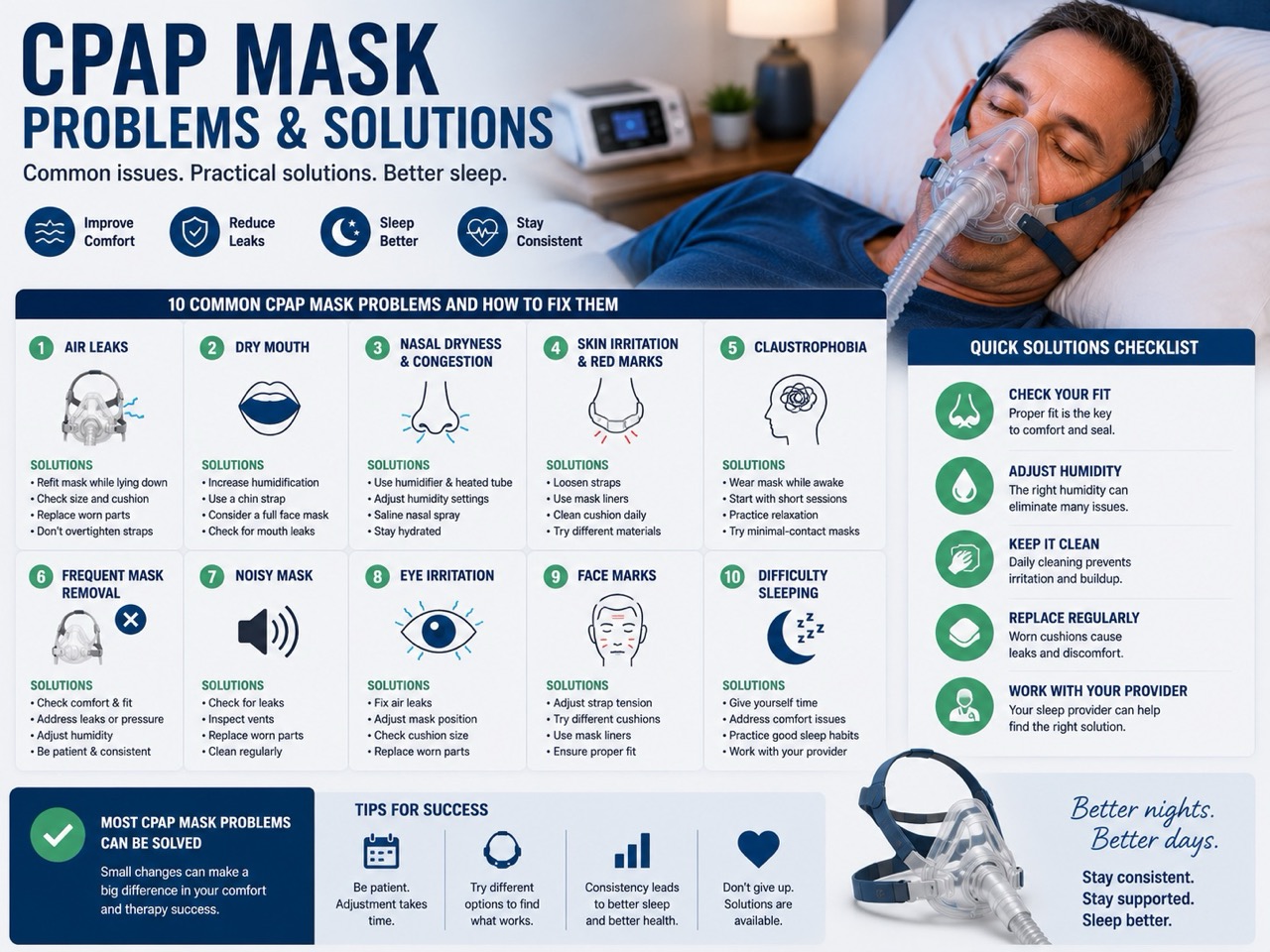
CPAP mask problems and solutions: fixing the most common therapy issues
Starting PAP therapy can be life-changing, but adapting to a CPAP mask is not always easy. Even patients who are highly motivated to improve their sleep sometimes encounter challenges that affect comfort, sleep quality, or treatment effectiveness.
The good news is that most CPAP mask problems can be solved. In many cases, small adjustments to mask fit, humidity settings, sleeping position, or equipment selection can dramatically improve comfort and therapy success.
Understanding the most common issues and their solutions can help patients overcome early frustrations and achieve long-term treatment success.
Why CPAP mask problems happen
Modern PAP masks are far more comfortable than older designs, but they still require proper fitting and adjustment.
Common factors that contribute to problems include:
- Incorrect mask size
- Improper fit
- Wrong mask type
- Worn equipment
- Pressure settings
- Sleeping position
- Facial structure
- Breathing habits
Most issues are not signs that PAP therapy has failed—they are simply part of the adjustment process.
Problem #1: Air leaks
Air leaks are among the most common PAP complaints.
Symptoms
- Air blowing into the eyes
- Whistling sounds
- Dry eyes
- Reduced therapy effectiveness
Common causes
- Loose headgear
- Incorrect mask size
- Worn cushions
- Movement during sleep
Solutions
- Refit the mask while lying down
- Replace worn cushions
- Try a different mask size
- Consider a different mask style
- Check headgear adjustments
Many users mistakenly tighten masks too much, which can actually worsen leaks.
Problem #2: Dry mouth
Dry mouth frequently affects PAP users, particularly those using nasal-only masks.
Symptoms
- Dry throat
- Morning thirst
- Mouth discomfort
- Bad breath
Common causes
- Mouth breathing
- Low humidity settings
- Air leaks
Solutions
- Increase humidification
- Use a chin strap
- Consider a full face mask
- Review mask fit
Problem #3: Nasal dryness and congestion
Some users experience nasal irritation during therapy.
Symptoms
- Dry nose
- Congestion
- Nosebleeds
- Irritation
Solutions
- Heated humidification
- Heated tubing
- Saline nasal sprays
- Proper humidity adjustment
Modern humidifiers often eliminate these issues entirely.
Problem #4: Skin irritation
Facial irritation is common during the adaptation phase.
Symptoms
- Red marks
- Soreness
- Pressure points
- Skin sensitivity
Solutions
- Loosen overly tight straps
- Use mask liners
- Clean cushions regularly
- Try alternative cushion materials
Most irritation improves after fit optimization.
Problem #5: Claustrophobia
Many users initially feel uncomfortable wearing a mask.
Symptoms
- Anxiety
- Panic sensations
- Difficulty falling asleep
Solutions
- Wear the mask while awake
- Practice relaxation techniques
- Start with short sessions
- Consider nasal pillow masks
- Gradually increase usage time
Most users adapt successfully within several weeks.
Problem #6: Marks on the face
Temporary morning marks are common.
Causes
- Tight headgear
- Cushion pressure
- Poor fit
Solutions
- Adjust strap tension
- Try different cushion styles
- Use mask liners
- Review sizing
Persistent pressure marks should be evaluated.
Problem #7: Frequent mask removal
Some users unknowingly remove the mask during sleep.
Possible causes
- Pressure discomfort
- Claustrophobia
- Poor fit
- Air leaks
Solutions
- Evaluate comfort issues
- Optimize mask selection
- Adjust humidity settings
- Discuss therapy settings with your provider
Problem #8: Noisy mask
Noise can affect both patients and bed partners.
Common causes
- Air leaks
- Blocked vents
- Worn components
Solutions
- Inspect mask vents
- Replace worn parts
- Improve mask fit
- Clean equipment regularly
Most modern masks operate very quietly when functioning properly.
Problem #9: Eye irritation
Air leaking upward may irritate the eyes.
Symptoms
- Dry eyes
- Redness
- Watering
Solutions
- Improve seal positioning
- Try a different cushion size
- Replace worn components
Eye irritation almost always indicates a leak problem.
Problem #10: Difficulty sleeping with the mask
Many new users simply struggle to adjust.
Solutions
- Be patient
- Use the mask consistently
- Practice during daytime relaxation
- Address individual comfort issues
- Work with your sleep provider
Adaptation often takes several weeks.
When should you change masks?
You may benefit from a different mask if:
- Persistent leaks continue
- Comfort remains poor
- Claustrophobia persists
- Mouth breathing becomes problematic
- Skin irritation continues despite adjustments
Changing mask styles is common and often improves therapy dramatically.
The importance of persistence
Many successful PAP users experienced difficulties during their first weeks of therapy.
The difference between success and failure is often not the equipment itself, but the willingness to identify problems and make adjustments.
Most challenges have solutions.
CPAP mask problems are extremely common, especially during the early stages of therapy. Fortunately, most issues can be resolved through proper fitting, equipment adjustments, mask changes, or simple comfort improvements. Air leaks, dry mouth, skin irritation, and claustrophobia do not have to prevent successful treatment. With patience, education, and the right equipment, most patients can overcome these challenges and enjoy the full benefits of effective sleep apnea therapy.