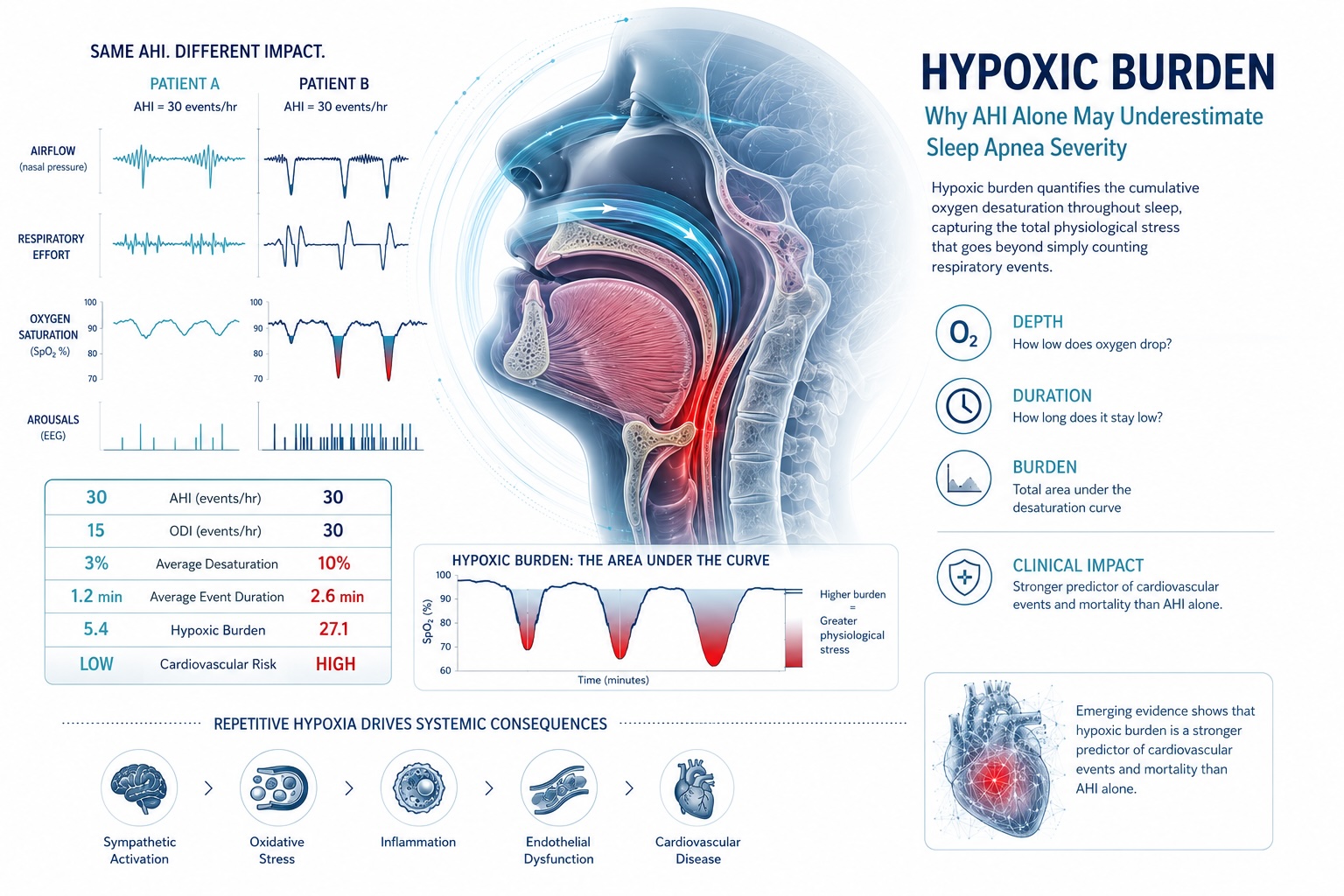
Hypoxic burden: why AHI alone may underestimate sleep apnea severity
For decades, obstructive sleep apnea (OSA) severity has been defined primarily by the Apnea-Hypopnea Index (AHI), a measure that counts the average number of respiratory events per hour of sleep.
Although AHI remains the foundation of diagnosis and treatment decisions, researchers increasingly recognize that event frequency alone may not accurately reflect the true physiological consequences of sleep-disordered breathing.
A patient with frequent but mild respiratory events may have the same AHI as another patient experiencing prolonged airway obstruction and profound oxygen deprivation. Yet their cardiovascular risk profiles may be dramatically different.
This discrepancy has led to growing interest in a newer metric known as hypoxic burden.
Hypoxic burden attempts to quantify not simply how often breathing disturbances occur, but how much oxygen-related stress they place on the body throughout the night.
Why oxygen deprivation matters
The most damaging consequence of obstructive sleep apnea is not the respiratory event itself.
Rather, it is the repeated cycle of:
- Airway collapse
- Reduced airflow
- Falling blood oxygen levels
- Arousal from sleep
- Reoxygenation
These repetitive episodes occur hundreds of times per night in severe disease.
Each cycle triggers:
- Sympathetic nervous system activation
- Oxidative stress
- Inflammatory signaling
- Endothelial dysfunction
- Blood pressure surges
Over time, these processes contribute to the development of cardiovascular and metabolic disease.
The degree of physiological stress depends not only on how many events occur, but also on how severe each oxygen desaturation becomes.
What is hypoxic burden?
Hypoxic burden is a measure of the cumulative oxygen desaturation associated with sleep-disordered breathing.
Unlike AHI, which simply counts events, hypoxic burden incorporates:
- Desaturation depth
- Desaturation duration
- Total area under the oxygen desaturation curve
In practical terms, it estimates the total “oxygen debt” accumulated during sleep.
A patient experiencing brief 3% desaturations will have a lower hypoxic burden than a patient with prolonged 8–12% desaturations, even if both have identical AHIs.
Understanding the concept visually
Imagine two patients.
Patient A
- AHI: 30 events/hour
- Average desaturation: 3%
- Rapid recovery after each event
Patient B
- AHI: 30 events/hour
- Average desaturation: 10%
- Prolonged oxygen recovery
Traditional scoring systems classify both patients as severe OSA.
However, Patient B experiences substantially greater oxygen-related physiological stress.
Hypoxic burden captures this difference.
AHI does not.
Why AHI can miss important risk information
AHI was designed to count respiratory events.
It does not account for:
- Event duration
- Depth of desaturation
- Oxygen recovery time
- Total hypoxic exposure
As a result, patients with similar AHIs may exhibit vastly different outcomes.
Researchers have long observed that some individuals with moderate AHI develop significant cardiovascular disease, while others with higher AHIs experience relatively few complications.
Hypoxic burden may help explain this variability.
The landmark research
Interest in hypoxic burden accelerated following several large cohort studies.
Researchers demonstrated that hypoxic burden showed stronger associations with:
- Incident heart failure
- Cardiovascular mortality
- Coronary artery disease
- All-cause mortality
than traditional AHI measurements.
Importantly, these associations often remained significant even after adjusting for AHI severity.
This suggests that oxygen stress may represent a more biologically meaningful marker of disease burden than event frequency alone.
Cardiovascular implications
Intermittent hypoxia affects nearly every component of the cardiovascular system.
Repeated oxygen deprivation contributes to:
Hypertension
Hypoxia activates the sympathetic nervous system, increasing blood pressure both during sleep and throughout the day.
Atrial fibrillation
Patients with greater nocturnal hypoxia demonstrate higher rates of cardiac rhythm disturbances.
Coronary artery disease
Hypoxia promotes endothelial injury and accelerates atherosclerosis.
Heart failure
Multiple studies have linked elevated hypoxic burden to future heart failure risk.
These relationships appear stronger than those observed with AHI alone.
Why some patients feel worse despite lower AHI scores
Clinicians frequently encounter patients who report profound fatigue despite relatively modest AHI values.
One explanation may be a disproportionate hypoxic burden.
A patient may experience:
- Fewer respiratory events
- Longer obstruction duration
- Deeper oxygen desaturation
leading to significant physiological stress despite a lower event count.
This helps explain why symptom severity and AHI often fail to correlate.
Relationship to oxygen desaturation index (ODI)
Hypoxic burden and Oxygen Desaturation Index (ODI) are related but distinct metrics.
ODI
Counts the number of oxygen desaturations per hour.
Hypoxic burden
Measures the cumulative impact of those desaturations.
An analogy is rainfall.
ODI counts how many times it rains.
Hypoxic burden measures how much rain actually falls.
Both provide useful information, but hypoxic burden captures overall exposure more comprehensively.
Can patients calculate hypoxic burden themselves?
Currently, hypoxic burden is primarily a research metric.
Most home sleep tests and CPAP reports do not display it directly.
Calculation requires:
- High-resolution oxygen saturation data
- Respiratory event timing
- Specialized analysis software
However, patients can review surrogate markers including:
- Lowest oxygen saturation (nadir SpO₂)
- Time spent below 90% oxygen saturation (T90)
- Oxygen Desaturation Index (ODI)
- Average desaturation depth
These metrics often provide clues regarding oxygen-related disease burden.
Will hypoxic burden replace AHI?
Probably not.
AHI remains:
- Simple
- Standardized
- Widely understood
- Central to current treatment guidelines
However, many experts believe future sleep apnea assessment will combine:
- AHI
- Hypoxic burden
- Arousal index
- Event duration
- Sleep architecture
- Symptom burden
Together, these measures provide a more complete picture of disease severity.
Rather than replacing AHI, hypoxic burden may become an essential companion metric.
The future of sleep apnea severity assessment
Sleep medicine is moving toward precision-based classification.
Researchers increasingly recognize that OSA is not a single disease but a collection of physiological phenotypes with varying risks and treatment responses.
Metrics such as hypoxic burden help move the field beyond simple event counting and toward a deeper understanding of how sleep apnea affects individual patients.
The future will likely focus less on how many events occur and more on the biological consequences those events produce.
Key takeaways
- AHI counts respiratory events but does not measure oxygen stress.
- Hypoxic burden quantifies cumulative oxygen desaturation throughout sleep.
- Patients with identical AHIs may have very different hypoxic burdens.
- Elevated hypoxic burden appears strongly associated with cardiovascular risk.
- The metric may help explain why symptoms and outcomes often differ among patients with similar AHI values.
- Future sleep apnea assessment will likely incorporate both AHI and hypoxic burden rather than relying on a single measurement.
References
- Azarbarzin A, Sands SA, Taranto-Montemurro L, et al. The Sleep Apnea-Specific Hypoxic Burden Predicts Incident Heart Failure.
- Malhotra A, Ayappa I, Ayas N, et al. Metrics of Sleep Apnea Severity Beyond the Apnea-Hypopnea Index.
- American Academy of Sleep Medicine (AASM) Clinical Resources.
- Eckert DJ. Phenotypic Approaches to Obstructive Sleep Apnea.