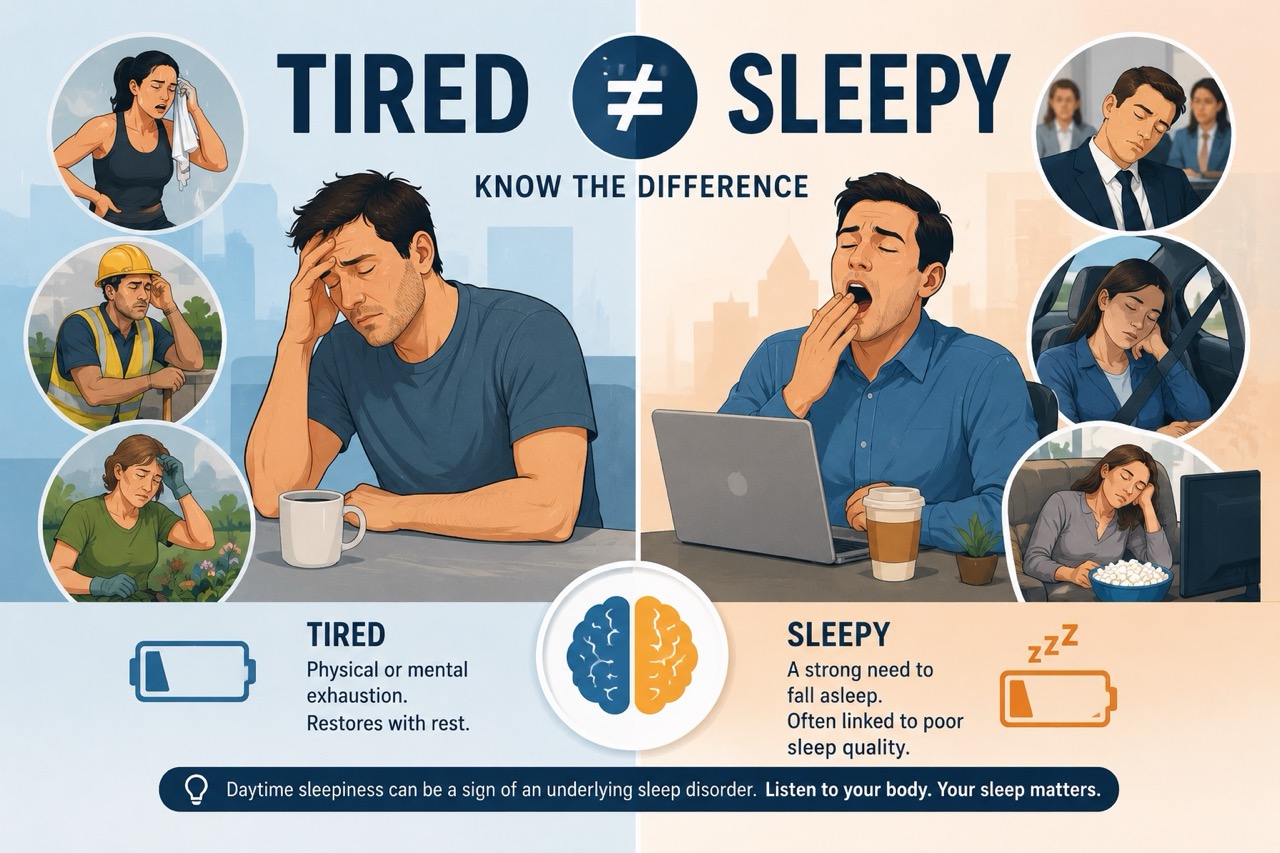
Why Feeling Sleepy Matters More Than You Think
The difference between being tired and being sleepy could reveal an underlying sleep disorder.
Most people use the words tired, fatigued, exhausted, and sleepy as if they mean the same thing.
In sleep medicine, they don’t.
This distinction is so important that an entire questionnaire—the Epworth Sleepiness Scale—was created to measure one specific thing:
How likely you are to fall asleep during the day.
Surprisingly, many people living with sleep apnea don’t realize that their symptoms are abnormal because they have adapted to feeling sleepy all the time.
“I’m Tired” Doesn’t Tell the Whole Story
Imagine two people.
Person A
- Worked in the garden all day
- Muscles feel sore
- Wants to rest
They’re tired.
But if they sit down to watch television, they remain fully awake.
Person B
- Slept eight hours last night
- Doesn’t feel physically exhausted
- Falls asleep halfway through a movie
They’re sleepy.
These are very different situations.
One reflects physical fatigue.
The other reflects a tendency to fall asleep.
Sleep specialists pay close attention to the second one.
Sleepiness Is a Biological Signal
Daytime sleepiness is not laziness.
It is often a sign that your brain is not getting the restorative sleep it needs.
When sleep becomes fragmented night after night, the body begins accumulating what researchers call sleep debt.
Eventually, the brain starts looking for opportunities to recover.
That’s when people begin falling asleep in situations where they intended to remain awake.
The Everyday Signs People Ignore
Many people assume excessive sleepiness only means falling asleep at work.
In reality, it often starts much more subtly.
You may notice yourself:
- Re-reading the same page repeatedly
- Missing parts of television programs
- Nodding off as a passenger in a car
- Struggling to stay alert after lunch
- Falling asleep during meetings
- Taking frequent naps
Because these situations feel ordinary, people often dismiss them.
The problem is that they may be early warning signs of a sleep disorder.
Why Sleep Specialists Ask Strange Questions
If you’ve ever completed the Epworth Sleepiness Scale, you may have wondered why it asks about situations like:
- Sitting and reading
- Watching television
- Riding in a car
- Sitting quietly after lunch
The reason is simple.
Sleepiness is easiest to detect when external stimulation is low.
Most people can force themselves to stay awake during exciting activities.
Passive situations reveal what is really happening underneath.
Sleepiness and Sleep Apnea
Obstructive sleep apnea repeatedly disrupts breathing during sleep.
Many people experience dozens—or even hundreds—of breathing interruptions every night.
Even if they do not fully wake up, these disruptions can prevent normal restorative sleep.
The result may be:
- Morning headaches
- Poor concentration
- Memory problems
- Irritability
- Excessive daytime sleepiness
This is why many sleep apnea patients report feeling tired no matter how long they stay in bed.
When Sleepiness Becomes Dangerous
Excessive daytime sleepiness is not merely inconvenient.
It can become dangerous.
Studies have linked untreated sleepiness with:
- Motor vehicle accidents
- Workplace injuries
- Reduced productivity
- Impaired concentration
- Poor academic performance
The risk becomes especially concerning when people begin falling asleep during activities that require constant attention.
A Quick Reality Check
Ask yourself these questions:
Could you fall asleep while reading?
Could you fall asleep while watching television?
Could you fall asleep as a passenger during a one-hour drive?
Could you fall asleep sitting quietly after lunch?
Have you ever struggled to stay awake during a meeting?
If several of these situations sound familiar, your daytime sleepiness may be more significant than you realize.
Why Many People Don’t Notice the Problem
One of the most surprising findings in sleep medicine is how quickly people adapt.
Someone who has slept poorly for years may assume:
“This is just how everyone feels.”
It isn’t.
Many patients diagnosed with sleep apnea only realize how sleepy they were after treatment begins and their symptoms improve.
What Should You Do If You’re Often Sleepy?
Occasional sleepiness happens to everyone.
However, persistent daytime sleepiness deserves attention.
Consider further evaluation if you:
- Frequently fall asleep unintentionally
- Struggle to stay awake during passive activities
- Snore loudly
- Wake with headaches
- Feel unrefreshed despite adequate sleep
- Have witnessed breathing pauses during sleep
Tools such as the Epworth Sleepiness Scale and STOP-BANG questionnaire can help estimate risk and determine whether additional testing may be appropriate.
Feeling sleepy is not the same as feeling tired.
While physical fatigue is often a normal response to exertion, excessive daytime sleepiness may be a sign that your sleep is being disrupted night after night.
Recognizing that difference is often the first step toward identifying sleep apnea and other sleep disorders. Sometimes the most important symptom isn’t how long you sleep—it’s how awake you feel when the day begins.