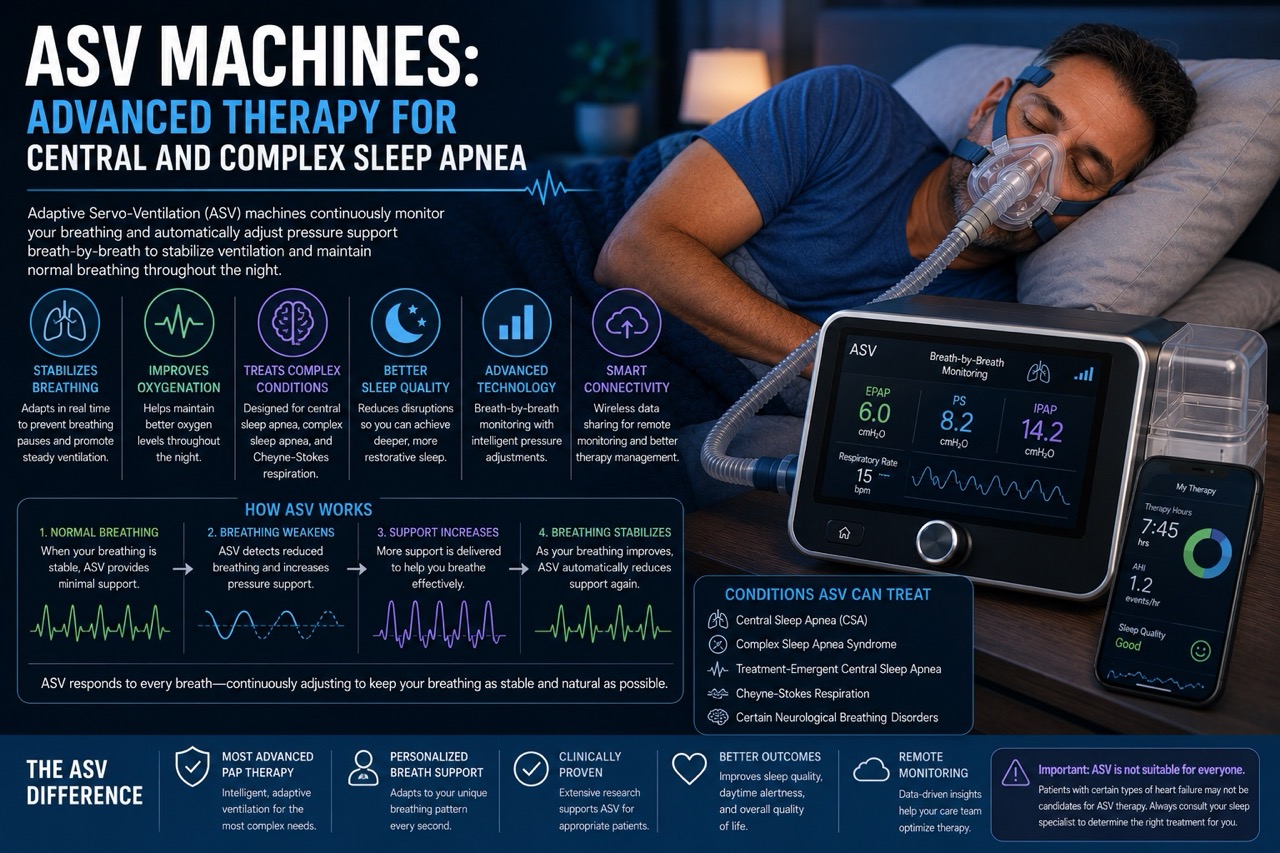
ASV machines: advanced therapy for central and complex sleep apnea
While CPAP, APAP, and BiPAP therapies successfully treat millions of people with obstructive sleep apnea, some patients experience breathing disorders that require a more sophisticated approach. For these individuals, Adaptive Servo-Ventilation (ASV) may provide the most advanced form of non-invasive sleep breathing support available today.
ASV technology continuously monitors every breath and automatically adjusts pressure support in real time. Unlike traditional PAP therapies that primarily prevent airway collapse, ASV actively responds to unstable breathing patterns and helps maintain normal ventilation throughout the night.
For carefully selected patients with central sleep apnea, complex sleep apnea, or certain breathing instability syndromes, ASV can dramatically improve sleep quality, oxygen levels, and overall health.
What is an ASV machine?
ASV stands for Adaptive Servo-Ventilation.
ASV devices are specialized positive airway pressure systems designed to stabilize breathing when the body’s natural respiratory control system becomes unstable.
Unlike CPAP, APAP, or standard BiPAP devices, ASV continuously analyzes:
- Breathing rate
- Breathing volume
- Airflow patterns
- Respiratory pauses
- Ventilation stability
The machine then makes breath-by-breath adjustments to maintain more normal respiratory function.
Why ASV was developed
Traditional PAP therapy is highly effective for obstructive sleep apnea because it prevents physical airway collapse.
However, some patients experience breathing problems that originate in the brain’s respiratory control system rather than the airway itself.
These conditions may include:
- Central Sleep Apnea (CSA)
- Complex Sleep Apnea Syndrome
- Treatment-Emergent Central Sleep Apnea
- Cheyne-Stokes Respiration
- Certain neurological breathing disorders
ASV was specifically developed to address these more complex respiratory patterns.
Understanding central sleep apnea
In obstructive sleep apnea:
- The brain sends breathing signals normally
- The airway becomes physically blocked
In central sleep apnea:
- The airway may remain open
- The brain temporarily stops sending breathing signals
As a result:
- Breathing pauses occur
- Oxygen levels may fall
- Sleep becomes fragmented
- Cardiovascular stress increases
Traditional CPAP therapy may not adequately address these breathing control abnormalities.
How ASV works
ASV continuously measures each breath.
When breathing is stable:
- Pressure support remains low
- Therapy remains comfortable
When breathing weakens:
- Pressure support increases
- Ventilation assistance rises
When breathing becomes excessive:
- Pressure support decreases
- Respiratory stability is restored
This process occurs continuously throughout the night.
Many ASV systems make adjustments hundreds or thousands of times during a single sleep session.
ASV versus CPAP
CPAP
- Fixed pressure
- Prevents airway collapse
- Primarily treats obstructive sleep apnea
ASV
- Dynamic pressure support
- Stabilizes ventilation
- Treats central breathing instability
CPAP focuses on the airway.
ASV focuses on the breathing control system.
ASV versus BiPAP
Although ASV devices use bilevel pressure technology, they are far more advanced.
BiPAP
- Fixed inspiratory pressure
- Fixed expiratory pressure
- May include backup respiratory rate
ASV
- Continuously changing pressure support
- Breath-by-breath adaptation
- Advanced ventilation targeting
ASV effectively acts as an intelligent respiratory support system.
Conditions commonly treated with ASV
Central Sleep Apnea (CSA)
One of the primary indications for ASV therapy.
Treatment-Emergent Central Sleep Apnea
Some patients develop central events after beginning CPAP therapy.
ASV may help stabilize breathing in these situations.
Complex Sleep Apnea Syndrome
A combination of obstructive and central sleep apnea patterns.
Cheyne-Stokes Respiration
A cyclical breathing pattern often associated with certain cardiovascular or neurological conditions.
Selected Neurological Disorders
Some patients with neurological conditions may benefit from advanced ventilatory support.
Benefits of ASV therapy
Improved breathing stability
ASV continuously responds to changing respiratory needs.
Reduced apnea events
Can significantly reduce central respiratory events.
Better oxygenation
Maintains more consistent oxygen levels throughout sleep.
Improved sleep quality
Fewer breathing interruptions often result in more restorative sleep.
Advanced personalization
Therapy adapts to each user’s unique breathing pattern.
Modern ASV technology
Today’s ASV systems include sophisticated capabilities.
Breath-by-breath analysis
Continuously evaluates respiratory patterns.
Dynamic pressure adjustment
Provides only the support needed at a given moment.
Backup ventilation
Supports breathing when respiratory effort decreases.
Advanced event detection
Identifies complex breathing disturbances.
Cloud connectivity
Allows healthcare professionals to monitor therapy remotely.
Detailed reporting
Provides extensive treatment analytics.
Who should not use ASV?
ASV is not appropriate for everyone.
Patient selection is extremely important.
Certain individuals with specific types of heart failure may not be suitable candidates for ASV therapy.
Because of this, ASV should only be prescribed and managed by qualified sleep and respiratory specialists following comprehensive evaluation.
Is ASV better than CPAP?
Not necessarily.
For obstructive sleep apnea:
- CPAP remains simpler
- CPAP remains highly effective
- CPAP is usually preferred
ASV becomes advantageous only when central breathing instability is present.
The most advanced device is not always the best device.
The best therapy is the one matched to the patient’s specific condition.
ASV adaptation and comfort
Many patients report excellent comfort once properly configured.
Because pressure support adjusts automatically:
- Breathing often feels natural
- Ventilation remains stable
- Sleep disruption decreases
Proper mask fitting and professional setup remain essential for success.
Cost considerations
ASV devices are typically among the most expensive PAP systems available.
Factors affecting cost include:
- Advanced hardware
- Sophisticated algorithms
- Specialized clinical support
- Ongoing monitoring requirements
However, for patients with complex respiratory disorders, the benefits often justify the investment.
The future of ASV
Artificial intelligence and machine learning are expected to further improve adaptive ventilation technologies.
Future systems may offer:
- Predictive breathing support
- Earlier event detection
- Improved comfort algorithms
- Personalized respiratory modeling
- Expanded remote monitoring capabilities
These innovations may make advanced therapy even more effective and accessible.
Adaptive Servo-Ventilation represents the most advanced form of positive airway pressure therapy currently available for sleep-disordered breathing. By continuously analyzing and responding to each breath, ASV provides highly personalized support for patients with central sleep apnea, complex sleep apnea, and other forms of breathing instability. While not necessary for most sleep apnea patients, ASV can be life-changing for individuals whose conditions require a level of respiratory support beyond what CPAP, APAP, or BiPAP can provide.