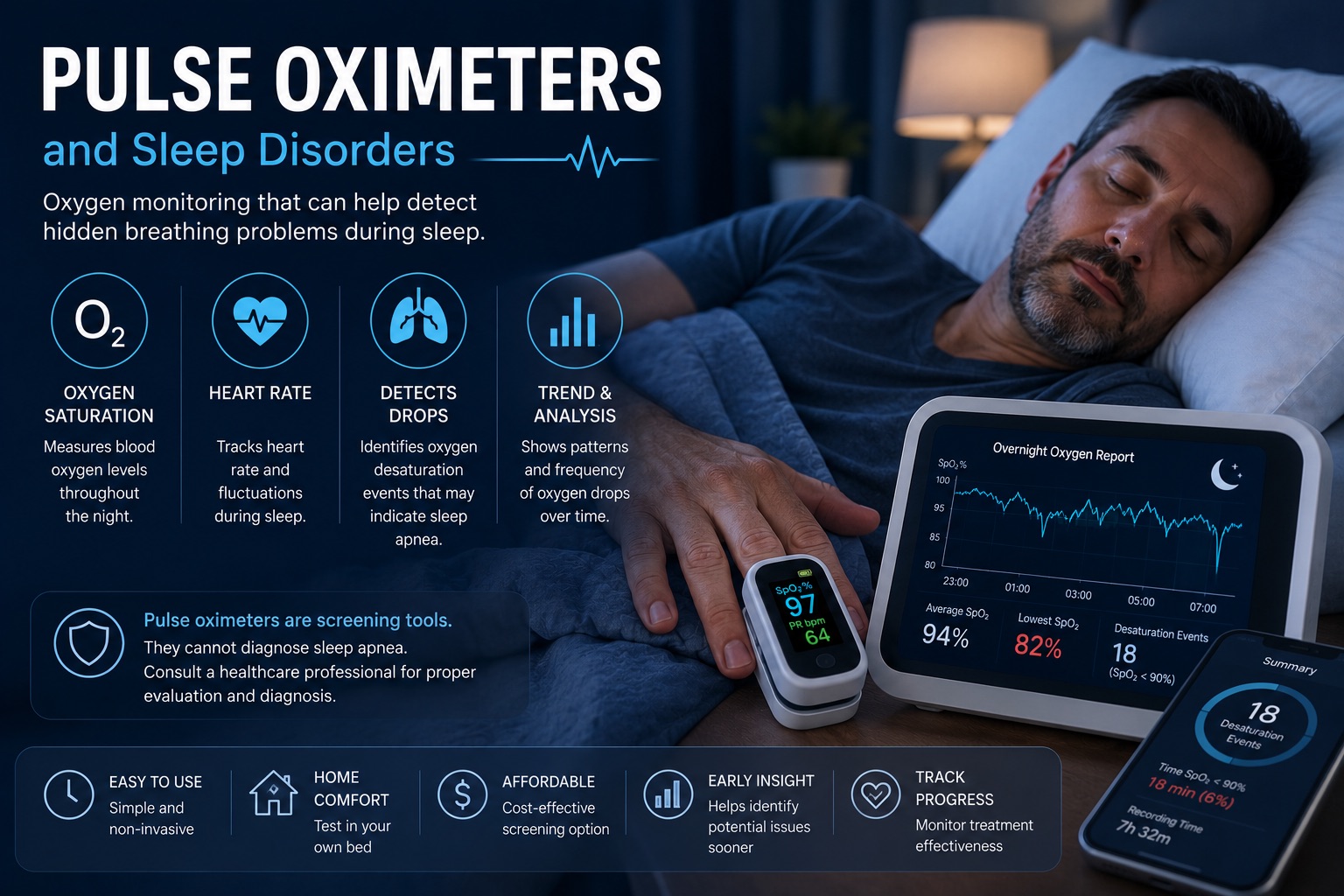
Pulse oximeters and sleep disorders: can oxygen monitoring detect sleep apnea?
Pulse oximeters are among the most widely used medical monitoring devices in the world. Small, affordable, and easy to use, they provide real-time measurements of blood oxygen saturation and heart rate. During the COVID-19 pandemic, these devices became common household tools, but their role in sleep medicine extends far beyond respiratory infections.
For individuals concerned about snoring, sleep apnea, or unexplained fatigue, pulse oximeters can provide valuable information about how oxygen levels behave during sleep. While they cannot diagnose sleep apnea on their own, they often play an important role in screening, monitoring, and treatment evaluation.
What is a pulse oximeter?
A pulse oximeter is a non-invasive device that measures:
- Blood oxygen saturation (SpO₂)
- Heart rate (pulse)
Most devices are placed on the fingertip and use light-emitting sensors to estimate how much oxygen is being carried by red blood cells.
Healthy individuals typically maintain oxygen saturation levels between 95% and 100% while awake and asleep.
Repeated drops below normal levels may indicate breathing disturbances that warrant further investigation.
Why oxygen matters during sleep
When breathing is normal, oxygen continuously enters the lungs and is delivered throughout the body.
During sleep apnea events, however, airflow may become partially or completely blocked.
As breathing stops or becomes restricted:
- Oxygen levels begin to fall
- Carbon dioxide levels rise
- The brain detects the disturbance
- Brief awakenings occur
- Breathing resumes
This cycle may repeat dozens or even hundreds of times each night.
Repeated oxygen desaturation places stress on the cardiovascular system and contributes to many of the long-term complications associated with untreated sleep apnea.
How pulse oximeters help identify sleep problems
Overnight oxygen monitoring may reveal patterns commonly associated with sleep-disordered breathing.
Possible warning signs include:
Repeated oxygen drops
Multiple oxygen desaturation events throughout the night may suggest sleep apnea.
Oxygen recovery cycles
A characteristic pattern of oxygen drops followed by rapid recovery often accompanies obstructive breathing events.
Elevated overnight heart rate
The body’s response to oxygen deprivation may cause heart rate fluctuations.
Prolonged low oxygen levels
Sustained oxygen reductions may indicate significant respiratory impairment.
These findings may prompt further evaluation with a Home Sleep Test (HST) or Polysomnography (PSG).
Can a pulse oximeter diagnose sleep apnea?
No.
Although pulse oximetry can identify abnormal oxygen patterns, it cannot directly diagnose sleep apnea.
A pulse oximeter cannot determine:
- Whether airflow stopped
- Why oxygen levels changed
- Sleep stages
- Respiratory effort
- Sleep position
- Sleep quality
For this reason, oxygen monitoring is considered a screening or supplemental tool rather than a definitive diagnostic test.
A person may have sleep apnea despite maintaining relatively normal oxygen levels during some events.
Likewise, low oxygen levels can result from conditions unrelated to sleep apnea.
Types of pulse oximeters used in sleep medicine
Finger pulse oximeters
The most common and affordable devices.
Typically used for spot checks and occasional monitoring.
Recording pulse oximeters
Designed to collect overnight data for later analysis.
These devices can generate detailed reports showing oxygen trends throughout the night.
Wearable oxygen monitors
Modern wearable devices may track oxygen saturation continuously during sleep.
Examples include:
- Smart watches
- Smart rings
- Dedicated sleep monitors
Accuracy varies significantly between manufacturers and models.
Clinical-grade oximetry systems
Used in hospitals, sleep laboratories, and professional diagnostic programs.
These systems generally provide the highest reliability and data quality.
Understanding oxygen saturation values
While exact interpretation should always be left to healthcare professionals, general reference ranges include:
Normal
95–100%
Mild reduction
90–94%
Significant reduction
Below 90%
Severe oxygen desaturation
Below 88%
Repeated nighttime desaturation events may indicate clinically significant breathing disturbances.
The frequency and duration of these events are often more important than a single isolated reading.
Pulse oximeters versus sleep studies
Many people wonder whether a pulse oximeter can replace a sleep study.
The answer is generally no.
A sleep study measures multiple physiological parameters simultaneously, while pulse oximetry measures only oxygen levels and pulse rate.
| Feature | Pulse Oximeter | Sleep Study |
|---|---|---|
| Oxygen levels | Yes | Yes |
| Heart rate | Yes | Yes |
| Airflow | No | Yes |
| Sleep stages | No | Yes |
| Respiratory effort | No | Yes |
| Sleep apnea diagnosis | No | Yes |
Pulse oximetry can indicate a problem may exist, but a comprehensive sleep study is usually required to determine the exact cause.
Monitoring treatment effectiveness
Pulse oximeters can be useful after a sleep disorder has already been diagnosed.
Healthcare professionals may use overnight oxygen monitoring to evaluate:
- CPAP therapy effectiveness
- Oxygen therapy response
- Post-surgical outcomes
- Disease progression
- Treatment adherence
Many patients find oxygen monitoring reassuring when starting sleep apnea treatment.
Limitations of pulse oximeters
Despite their usefulness, pulse oximeters have limitations.
Factors that may affect accuracy include:
- Poor circulation
- Cold hands
- Movement during sleep
- Incorrect sensor placement
- Dark nail polish
- Artificial nails
- Low-quality consumer devices
Results should always be interpreted in the context of symptoms, medical history, and professional evaluation.
Who should consider overnight oxygen monitoring?
Oxygen monitoring may be beneficial for individuals who:
- Snore heavily
- Experience daytime fatigue
- Have witnessed breathing pauses
- Wake gasping for air
- Have cardiovascular disease
- Are undergoing sleep apnea treatment
- Have chronic respiratory conditions
Anyone with concerning symptoms should seek professional medical advice rather than relying solely on consumer monitoring devices.
Pulse oximeters are valuable tools for monitoring oxygen saturation and identifying patterns that may suggest sleep-disordered breathing. Although they cannot diagnose sleep apnea independently, they often serve as an important first step in recognizing potential problems and guiding further evaluation. When combined with professional assessment and appropriate sleep testing, pulse oximetry can contribute to earlier diagnosis, more effective treatment, and improved long-term health outcomes.