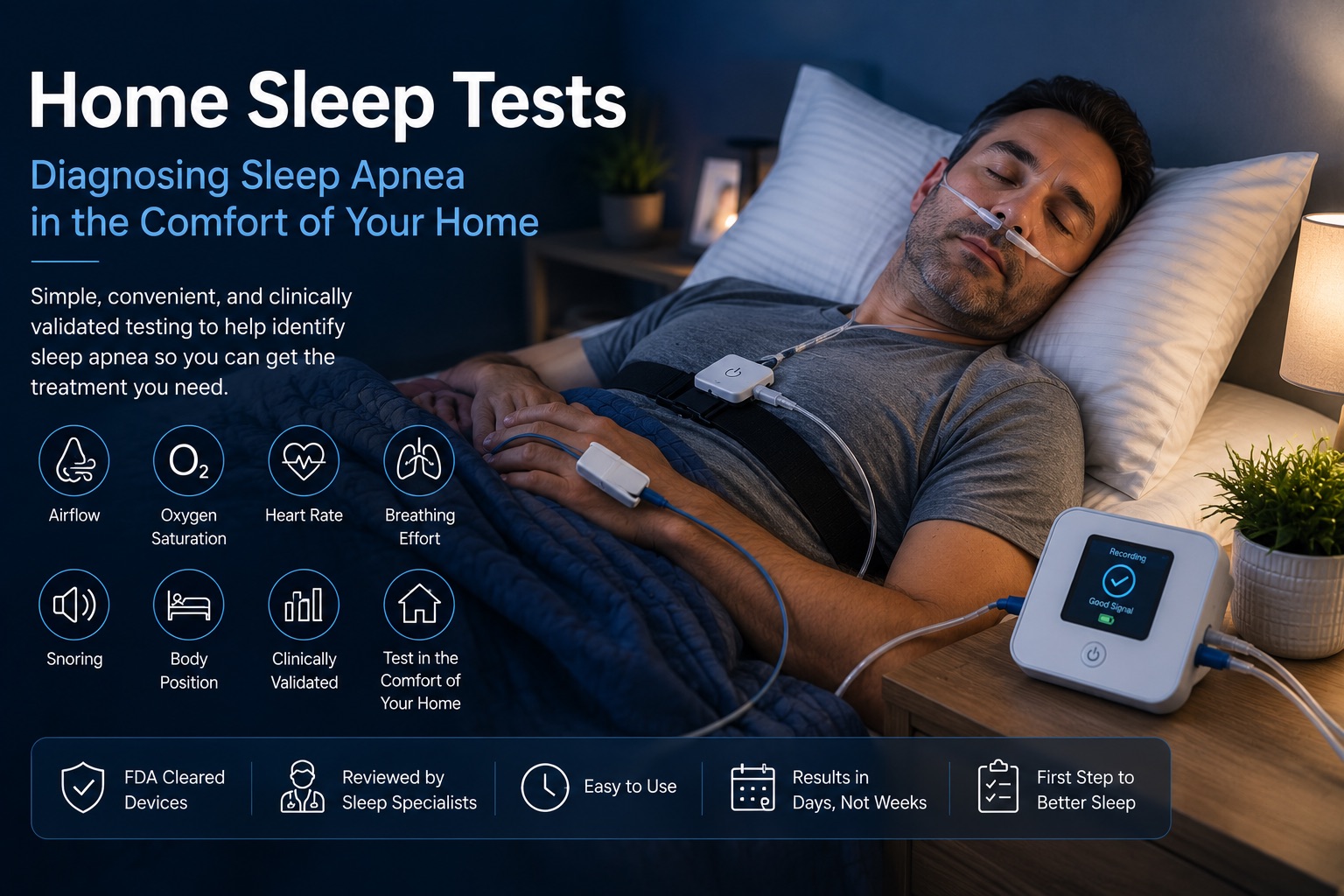
Home Sleep Tests (HST): diagnosing sleep apnea from the comfort of your home
For many people experiencing symptoms such as loud snoring, excessive daytime sleepiness, morning headaches, or witnessed breathing pauses during sleep, the first step toward diagnosis is often a Home Sleep Test (HST).
Home Sleep Tests have transformed sleep medicine by making sleep apnea screening more accessible, convenient, and affordable. Instead of spending a night in a sleep laboratory, patients can undergo testing in their own homes using portable monitoring equipment prescribed by a healthcare provider.
While Home Sleep Tests do not replace comprehensive laboratory sleep studies in every situation, they have become an effective diagnostic tool for many individuals with suspected obstructive sleep apnea.
What is a Home Sleep Test?
A Home Sleep Test is a portable diagnostic study designed to monitor breathing and related physiological signals during sleep.
Unlike polysomnography (PSG), which measures numerous neurological and physiological parameters, HST focuses primarily on identifying breathing abnormalities associated with sleep-disordered breathing.
Patients receive a compact monitoring device and wear several sensors overnight while sleeping in their usual environment.
The recorded data is later analyzed by trained professionals and reviewed by a sleep specialist.
What does an HST measure?
Depending on the device used, a Home Sleep Test may record:
Airflow
A small nasal cannula measures airflow through the nose and helps identify breathing interruptions.
Oxygen Saturation (SpO₂)
A pulse oximeter placed on the finger continuously measures blood oxygen levels throughout the night.
Heart Rate
Many systems monitor heart rate and heart rate variability to evaluate cardiovascular responses to respiratory events.
Respiratory Effort
Elastic belts around the chest or abdomen measure breathing effort and help distinguish different types of breathing disturbances.
Snoring
Some devices record snoring intensity and frequency.
Body Position
Advanced systems may determine whether breathing problems occur more frequently while sleeping on the back, side, or stomach.
Why are Home Sleep Tests used?
Home Sleep Tests are primarily used to evaluate suspected obstructive sleep apnea (OSA).
Common symptoms that may prompt testing include:
- Loud chronic snoring
- Witnessed breathing pauses
- Gasping or choking during sleep
- Excessive daytime sleepiness
- Morning headaches
- Difficulty concentrating
- Poor sleep quality
- Resistant hypertension
When symptoms strongly suggest obstructive sleep apnea, an HST can often provide sufficient information to establish a diagnosis.
Advantages of Home Sleep Testing
Convenience
Patients sleep in their own beds rather than in an unfamiliar clinical environment.
Faster access
Many healthcare systems can provide Home Sleep Tests more quickly than laboratory studies.
Lower cost
HST is generally less expensive than overnight polysomnography.
More natural sleep
Some individuals sleep more comfortably at home, potentially producing more representative results.
Increased accessibility
Portable testing helps expand access to diagnosis in rural areas and regions with limited sleep laboratory capacity.
Limitations of Home Sleep Tests
Although highly useful, HST devices have important limitations.
No direct sleep measurement
Most Home Sleep Tests do not measure brain activity and therefore cannot determine actual sleep stages.
Limited diagnostic scope
HST is designed primarily for sleep apnea evaluation and may not detect many other sleep disorders.
Reduced data collection
Compared with PSG, fewer physiological signals are recorded.
Potential for incomplete studies
Improper sensor placement or equipment issues may reduce data quality.
Not ideal for complex cases
Patients with multiple medical conditions or unusual symptoms may require laboratory testing.
HST versus polysomnography
Many patients wonder whether a Home Sleep Test is as accurate as a laboratory sleep study.
The answer depends on the clinical situation.
Home Sleep Test
Best suited for:
- Suspected obstructive sleep apnea
- Adults with typical symptoms
- Lower-risk diagnostic situations
- Initial screening
Polysomnography (PSG)
Preferred for:
- Complex sleep disorders
- Central sleep apnea evaluation
- Neurological sleep disorders
- Pediatric sleep studies
- Inconclusive HST results
While PSG remains the gold standard, Home Sleep Tests have proven highly effective for diagnosing moderate to severe obstructive sleep apnea in appropriately selected patients.
How accurate are Home Sleep Tests?
Modern HST systems provide excellent diagnostic performance for obstructive sleep apnea when used in suitable patients.
However, accuracy depends on:
- Device quality
- Proper sensor placement
- Adequate recording time
- Patient characteristics
- Professional interpretation
For patients with straightforward symptoms and high suspicion of OSA, Home Sleep Tests can often provide clinically meaningful results comparable to laboratory studies.
What happens after the test?
Once the recording is completed, the device is returned to the provider or sleep clinic.
Sleep specialists analyze the collected information and evaluate:
- Breathing interruptions
- Oxygen desaturation events
- Snoring patterns
- Respiratory effort
- Apnea-Hypopnea Index (AHI)
Based on these findings, the healthcare provider may recommend:
- CPAP therapy
- APAP therapy
- Oral appliance therapy
- Positional therapy
- Lifestyle modifications
- Additional diagnostic testing
Can a Home Sleep Test diagnose all sleep disorders?
No.
Home Sleep Tests are specifically designed to identify sleep-disordered breathing and are not intended to diagnose every sleep condition.
Patients with symptoms suggestive of:
- Narcolepsy
- Parasomnias
- REM Sleep Behavior Disorder
- Periodic Limb Movement Disorder
- Complex insomnia
- Neurological sleep disorders
may require additional testing, often including polysomnography.
Who should consider a Home Sleep Test?
A Home Sleep Test may be appropriate if you:
- Snore loudly
- Frequently feel tired during the day
- Have witnessed breathing pauses during sleep
- Wake up gasping or choking
- Have high blood pressure associated with sleep apnea risk
- Have been referred by a healthcare professional for sleep apnea evaluation
Early diagnosis can help reduce the risk of complications associated with untreated sleep apnea, including cardiovascular disease, stroke, diabetes, and impaired quality of life.
Home Sleep Tests have made sleep apnea diagnosis more accessible than ever before. By allowing patients to undergo testing in the comfort of their own homes, these portable devices provide a practical and cost-effective way to identify breathing disturbances during sleep. While they do not replace comprehensive laboratory polysomnography in every situation, Home Sleep Tests have become an essential tool in modern sleep medicine and often represent the first step toward effective treatment and better sleep health.